
A bright, yellow-white streak suddenly branched and zig zagged above the South Dakota plain. Another bolt lit up an immense silhouette of a cumulonimbus cloud. With each flash, the storm cloud was blowing closer to us.
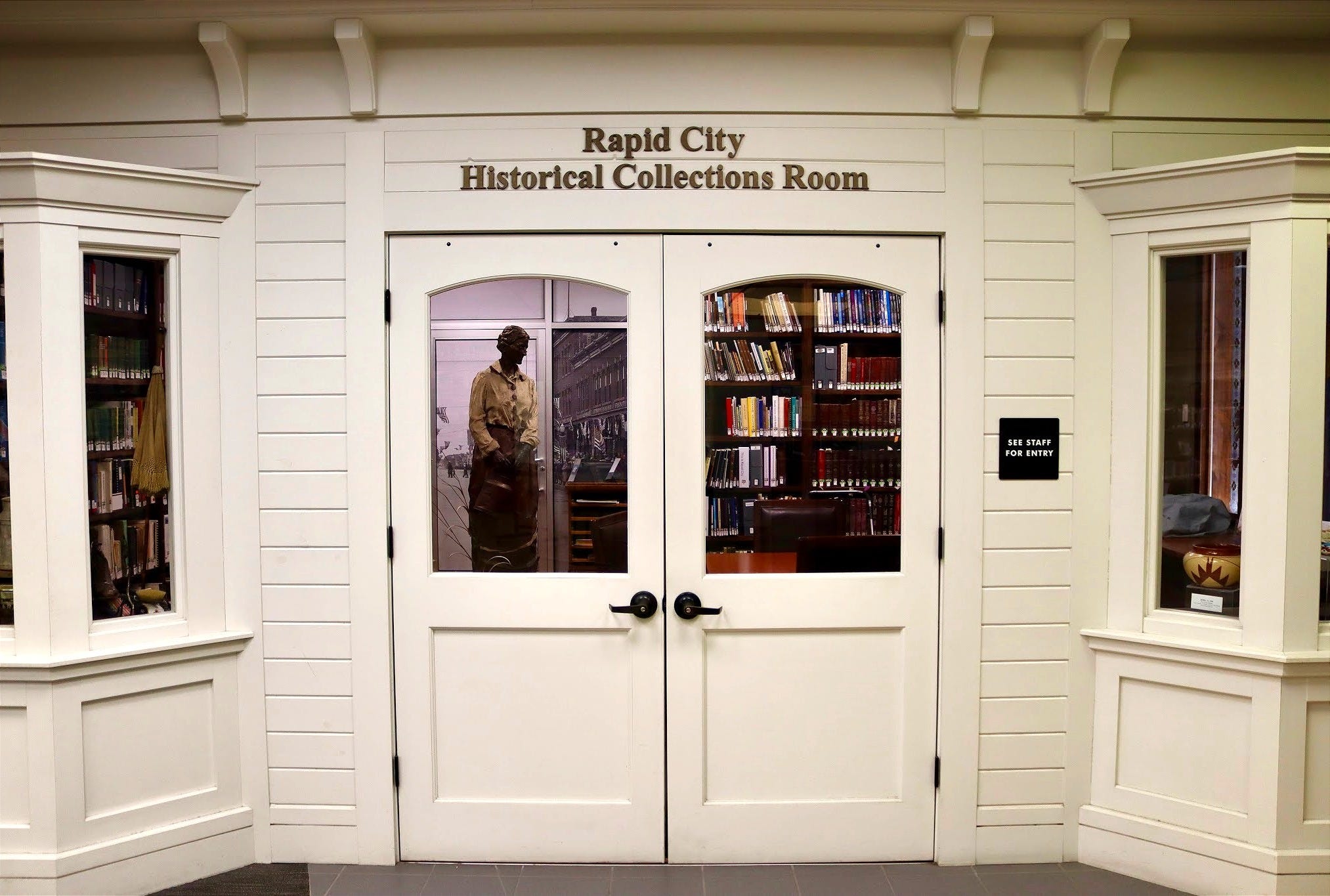
A few hours earlier, I had been reading about the tempestuous South Dakota Black Hills in the quiet solitude of Rapid City Library’s Historical Collections Room. A book of poems by the “cowboy poet,” Badger Clark, had grabbed my attention. I pulled the 1935 collection titled Sky Lines and Wood Smoke off the shelf and read the introduction. Clark, I learned, was the first poet laureate of South Dakota. He wrote most of his poetry in the Black Hills forest, where he lived in a secluded cabin called “the Badger Hole.”
I thumbed through the collection and found Clark longing to be alone in the Black Hills landscape:
Let me get out in the hills again,
I and myself alone,
Out through the wind and the lash of rain
To find what we really own.
Under the stars while a campfire dies
Let me sit and look myself in the eyes.
(“I and Myself”)
Looking out at the hills, the wind, the rain, and the stars, Clark sees a pair of eyes returning his gaze. Those eyes are his own – he is immersed in a moment of self-reflection – but they are also eyes that emerge from the Black Hills forest. The forest looks back at Clark, and Clark is the forest.
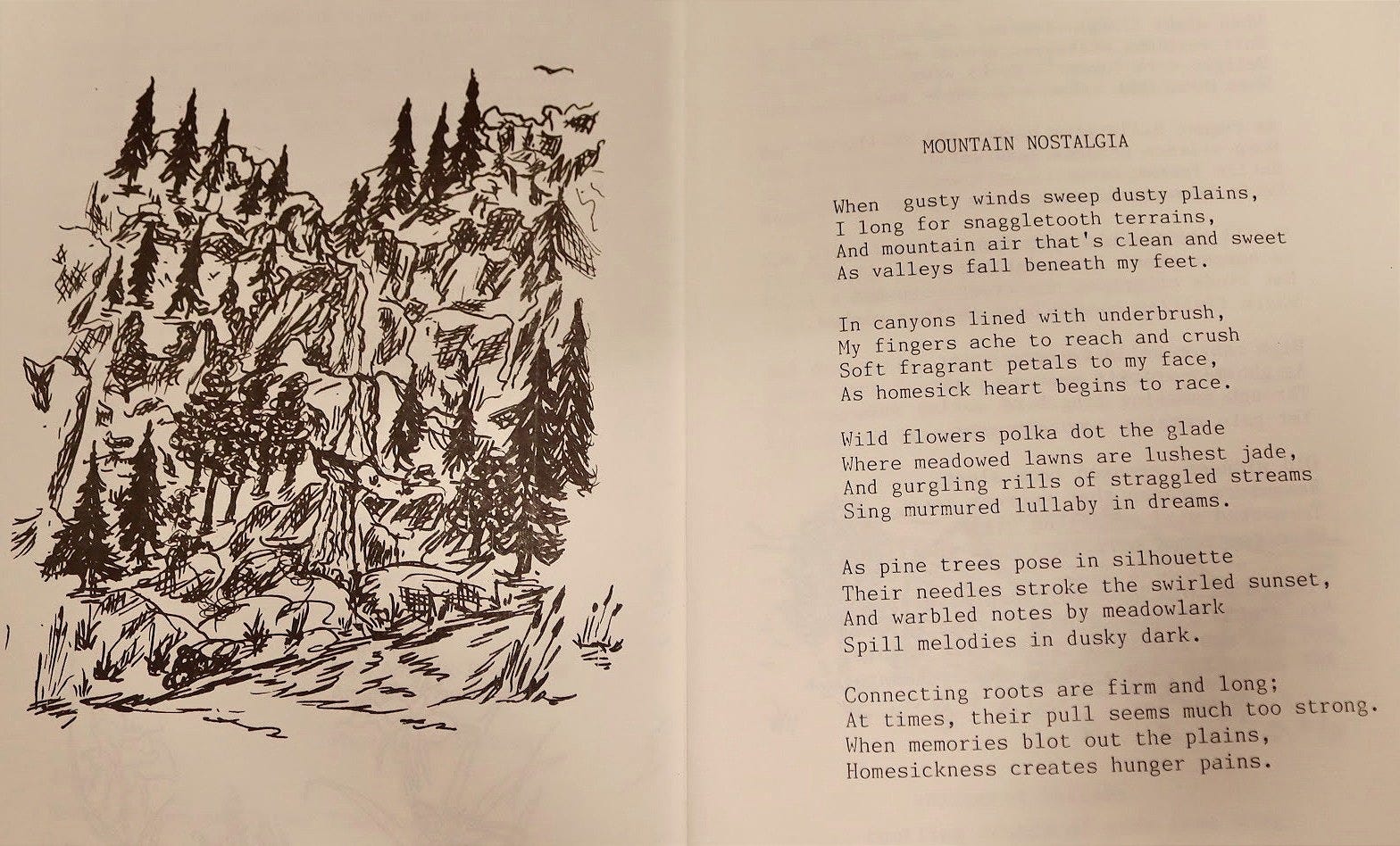
I picked up another book of poetry from the shelf titled Echoes from the Black Hills by Marianne McFarland McNeil (1984). One poem, “Mountain Nostalgia,” gave me a peak into what the “snaggletooth terrains” of the Black Hills must be like in the spring:
Wild flowers polka dot the glade
Where meadowed lawns are lushest jade,
And gurgling rills of straggled streams
Sing murmured lullaby in dreams.
McNeil’s flowers, lawns, and streams sing and dream – like Clark’s Black Hills, they are vibrant and alive. Yet the dulcet “gurgling rills,” hushed lullabies, and sing-song rhythms of McNeil’s Black Hills meadow are sweeter than the harsh “lash[ing] of rain” that Clark experiences. I wondered at the range of characteristics that the land could take on at different times of the year, and thought of how powerful, violent forces might be dormant beneath spring’s softness.
Reading further in the library’s Historical Collections Room, I learned more about the violent undercurrent pulsing through the Black Hills and the town near its foothills, Rapid City. I discovered that the heart of Rapid City is a flood plain. Historically, this has meant that locals lived only one hard rain away from being swept up by a river surge. In 1972, hundreds of people died when fifteen inches of rain fell during a storm and the river overflowed. Today, to avoid future disasters, the flood plain has been converted into a green park that can absorb the river’s turbulence.
Part way through my immersion in the library’s archive of South Dakota’s cultural memory of the Black Hills, I discovered the hidden gem of the forest: Mount Rushmore! Charles P. “Soldier” Green, a local poet, boxer, and soldier who fought in the Spanish-American War and the Philippines, wrote of the enormous presidential visages in 1930, while it was being constructed:
We have carved an epic picture
With a sculpture maul and knife.
In the Black Hills we have placed it—
Paired with Time’s undying fame—
[…]
On Rushmore’s granite face we see
Democracy’s nobility—
In Washington and Jefferson—
Who dared King’s right to scorn.
And Lincoln’s love we harmonize
In granite “Grey” and deep “Blue” skies,
While Roosevelt sounds the reveille
To greet each smiling morn.
(“Lakota”, Black Hills Ballads)
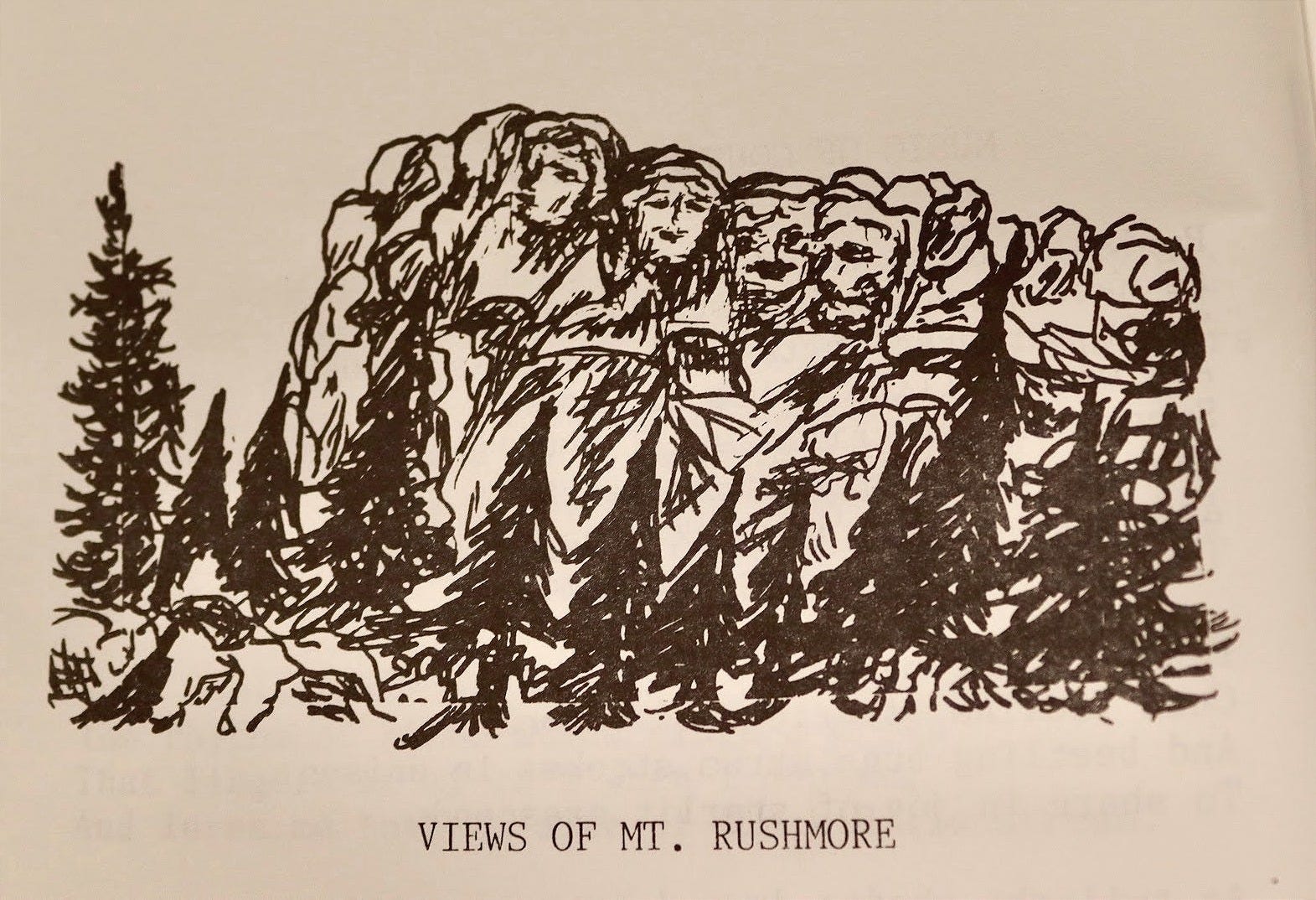
Later, in 1984, McNeil was also inspired by how the colossal sculpture carved the great feat of American democracy into “Time’s undying fame”:
Four granite faces towered high
Gaze fixedly at space,
Where needled spruce and pine stand guard;
Pride humbled, heartbeats race.
Huge sculptured faces from the past
Are part of history
That mortals carved on rocky page—
What do they hear— and see?
(“Views of Mt. Rushmore”)
McNeil directs our attention from the faces of Mount Rushmore to where Washington, Jefferson, Lincoln, and Roosevelt are looking. The presidents’ view from their Black Hills outcrop is of the South Dakota plains, but it is also of us, looking up at them. McNeil reminds us that our forebears are watching on and instills a sense of accountability in her reader.
Ollie and I left the archives and went upstairs to learn more about the Black Hills from a State Park Naturalist who was giving a talk about the Elk in Custer State Park, a wildlife reserve in the southern part of the Black Hills.
We took a seat next to three young children and their parents and tried to make sense of the list of strange words displayed at the front of the room: bugling, velvet, calving, antler shedding, calf dropping, the rut, bachelor pods. Sean, the Naturalist, asked the room: does anyone know what seasons these Elk behaviors occur in? To our surprise, everyone else seemed to be familiar with the terms already, and several of the young children shot their hands up with confidence to give their guesses.
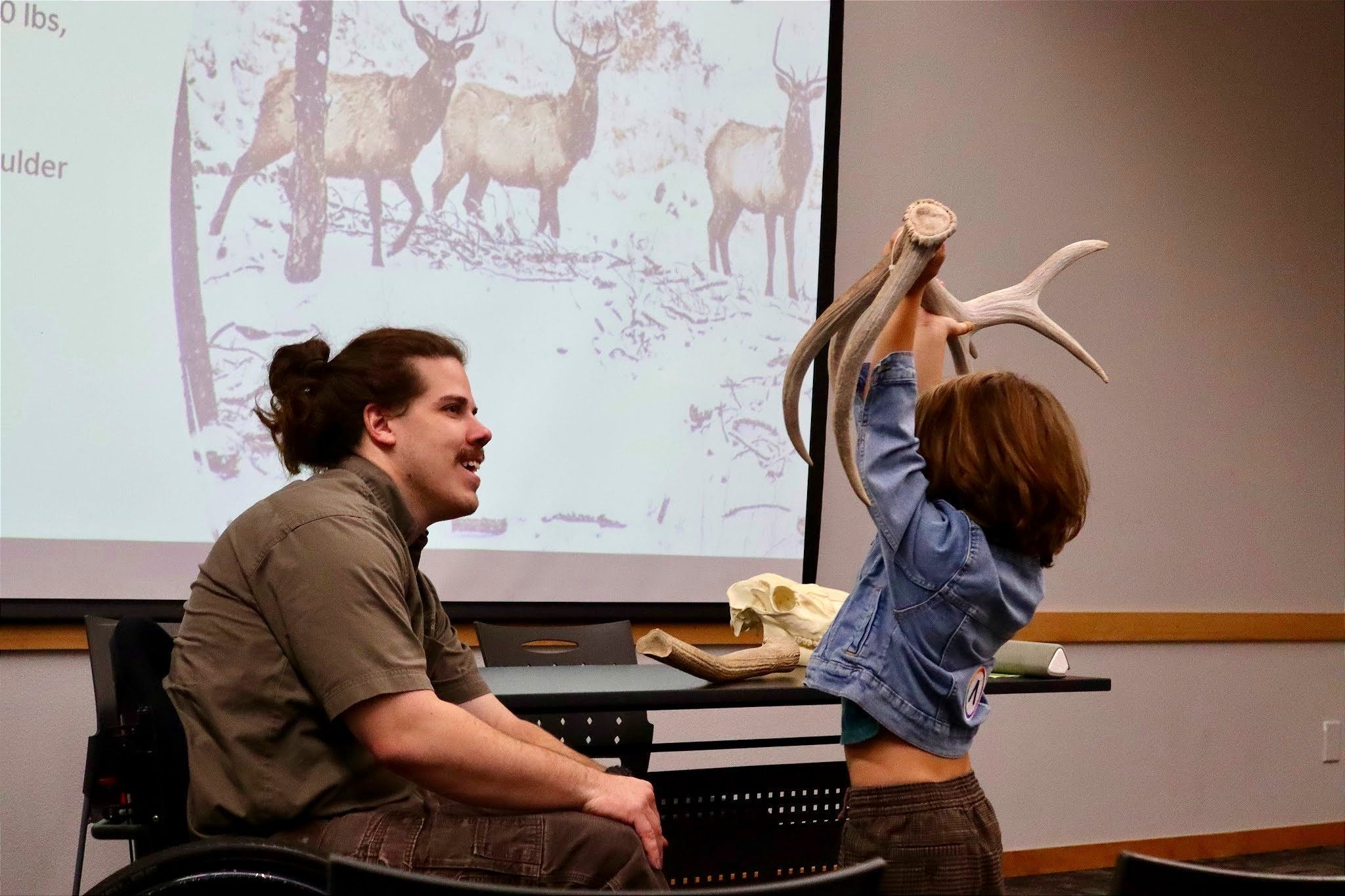
Sean recorded their responses and said we would get a second try at the end of the presentation. We dove into Elk phenomenology (the study of animal behavior) and learned that in the Spring, calves are “dropped” (birthed) camouflage and odorless, so that they have a chance of avoiding their most frequent predator: Grizzly Bears. When they reach twenty minutes old, they can start to run. In the first few weeks of their lives, they gain two pounds a day. Sean passed around several pairs of antlers as he explained that older Elk shed their antlers during this time. One brave little boy ran up to the front of the room and held the antlers above his head as though he were imagining himself becoming the Elk.
“The rut” – the period when Elk breed – happens in the summer, Sean explained. Male Elk bugle to attract females: the longer they bugle and the higher their pitch, the more attractive they are. Sean encouraged us all to head to Custer State Park after the talk, where we could hear the bugles for ourselves. But in case we didn’t have the chance, Sean blasted loud screeching bugle wails from his computer, which I’m sure raised several eyebrows in other parts of the library. During the summer, new growth on the males’ antlers feel like velvet – these cells are some of the fastest regenerating cells in the animal kingdom! Later, in the fall and winter, the Elk migrate to lower-altitude regions as the females undergo an eight-month gestation period.
After the audience had successfully tested their recall by correctly ordering the Elk behaviors, Sean ended the talk and several grateful parents thanked him for his time. We waited around and asked Sean about the library’s involvement with the Custer State Park. The library, he told us, is where the Parks Department gets access to the Rapid City community. The library hosts monthly talks by the Parks Department, which “lets us bring the park to them,” Sean said.
As we walked around the spacious library after the talk, we encountered more ways that the Rapid City Library brings environmental awareness into the library: a new seed library helps patrons learn about plants and help them combat food insecurity; the maker space has programs that teach patrons how to repurpose waste by building crafts using only recycled material.
As we left the library, we said good-bye to the library’s weekend manager, who told us he had worked in the Rapid City Library for sixteen years. “Our main goal is to be open to everyone,” he said. I immediately thought back to one of Green’s poems that I had read in the local history room. Like this librarian, Green had wanted to share his beautiful South Dakota home with everyone:
Our hands go out to every one
Of any race or station:
Our Welcome includes one and all
To share our exultation.
(“A Black Hills Greeting”)
I saw how Green and the Rapid City Library embody the same inclusive spirit – they both aim to share the wondrous Black Hills with everyone, no matter who they are.
Sitting in the parking lot, Ollie and I felt an urge to explore the beauty of the Black Hills for ourselves. First, we drove to Mount Rushmore, where the “Four granite faces tower[ing] high” in McNeil’s poem popped out of our imaginations onto the huge canvas of rock before us.
Then, we needed to find a place to camp for the night. Perhaps, we thought, we too could experience the deep self-reflection and connection with the land that Clark felt when he was alone in the forest. We drove up to a meadow in the Black Hills that looked out onto the South Dakota plains and set up camp. We watched the sun set as we cooked and ate a delicious mackerel couscous dinner, and sat alone with the pines and spruces under the night sky.
A roar of thunder and several bolts of lightning suddenly appeared in the distance. The storm’s claps and flashes grew louder and louder, and my poetic encounter with the wind and lashing rain in Clark’s poem seemed like it was about to become my reality. But unlike Clark, I wasn’t sure if I had the stoicism – or the wisdom of a local – to endure the storm.
I took out my phone and nervously discharged the series of words troubling my mind into google: “camping tent with metal rods lightning dangerous.” Of course, the first link I clicked on was the “freak accident” that had occurred nearby three years earlier – a young camper was struck and killed by lightning while sleeping in his tent. In my mind, our idyllic, secluded meadow turned into a death trap. In a moment, I saw both the soft and the harsh aspects of the Black Hills that McNeil and Clark had respectively evoked.
We had hoped that the storm might pass south of our camp, but a front of wind hit and moved us to action. Everything that hadn’t been anchored to the floor was suddenly airborne. Flashes of lightning started to strike every few seconds. As we rushed to pack up our tent and kitchen set-up, I took a moment to look up at the bright white lines veining the sky. It was the most electricity that I have ever seen at once.
An hour later, we were enjoying the comforts and shelter of a Travel Lodge, where we watched the storm roll in from the hotel TV. The imperative, “Electricity storm and flash flood alert – stay inside and away from windows,” ran across the bottom of the screen as a meteorologist gesticulated the moving outlines of the thunderstorm.
As we drifted to sleep, I listened to the wind whistling through the window sash and the patter of rain lashing against the pane, and pictured myself sitting next to Clark around the campfire, looking out at a forest staring back at me.
~
Carmen Vintro
To read more stories from America’s public libraries, subscribe to our Substack below, visit our website, and follow us on social media.
oncemore txs Carmen for very real and significant piece
Great story as usual ! I love the drawing - poetry pairings !