
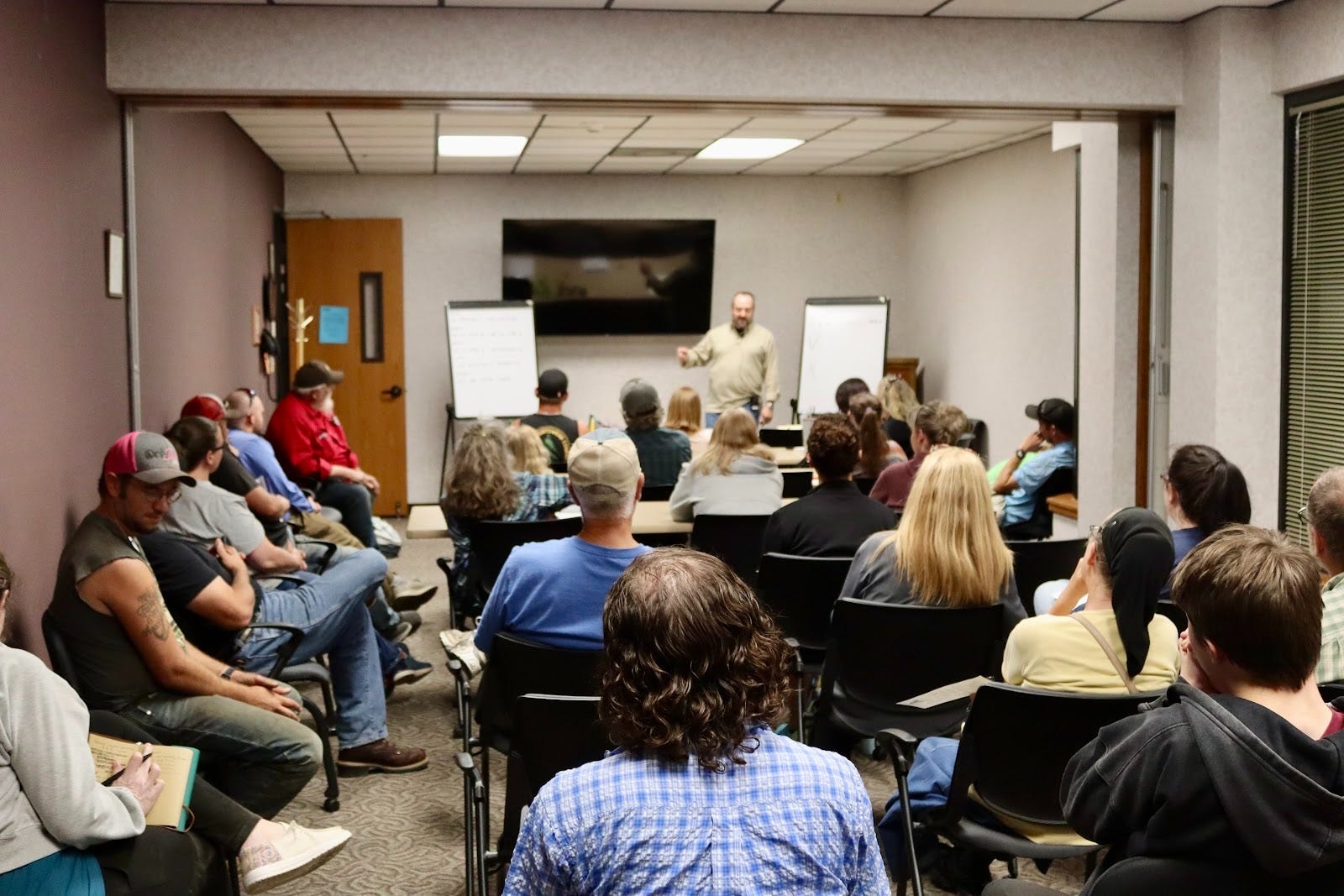
A man in the audience lifted his snoozing daughter from his lap, placed her on the chair next to him, and strode to the front of the room. The speaker, Chris, stopped explaining why you should always carry a plastic whistle and stepped back for him to speak.
With a smile, the man pulled a small bronze tube from his pocket and held it out for the audience to see. A metallic clang rang across the room as he slammed the empty bullet casing on the table and said, “If you blow on the top, you can whistle for help.”
“Yes,” Chris replied, “If you want lead poisoning.”
“No sir, that’s 100% copper.”
…
My mother took me to our local library most weekends when I was a child. I learned a lot there: reading, socialising, using a computer. I learned how to judge a book by its cover, and later, how not to. Still, I never expected to leave a library having learned how to survive getting lost in the American wilderness.
That changed when Carmen and I visited Campbell County Library in Gillette, Wyoming for the second session in their four-part “Learn About Wilderness Safety” series, run by the County Sheriff Posse’s Search and Rescue Team.
Today’s lesson: signaling and communication. Present: three children and forty-odd adults, mostly hunters, ranchers, and hikers. We could tell that most, if not all, of the attendees were locals from the roar of laughter after Chris asked, “What do we do when we hear someone got lost?” and someone shouted back, “Tell them - go back to California!”
Speaker Chris Jess has been a member of the Sheriff Posse’s Search and Rescue Team for 30 years. In that time, he’s seen his share of lost “Californians” (i.e., ill-prepared city slickers weekending in the wild - a stereotype we had been fulfilling for the past month) in the wilderness that expands out of Gillette. Most of these people are found wandering the plains of the Powder River Basin or stuck on the jagged ridges of the Bighorn Mountains. But he’s also found storm-struck ranchers lost on their own property and countless people who didn’t even know they were missing. And of course, in all those years of service, Chris has seen what happens when Search and Rescue arrive too late, and a person cannot be recovered alive.
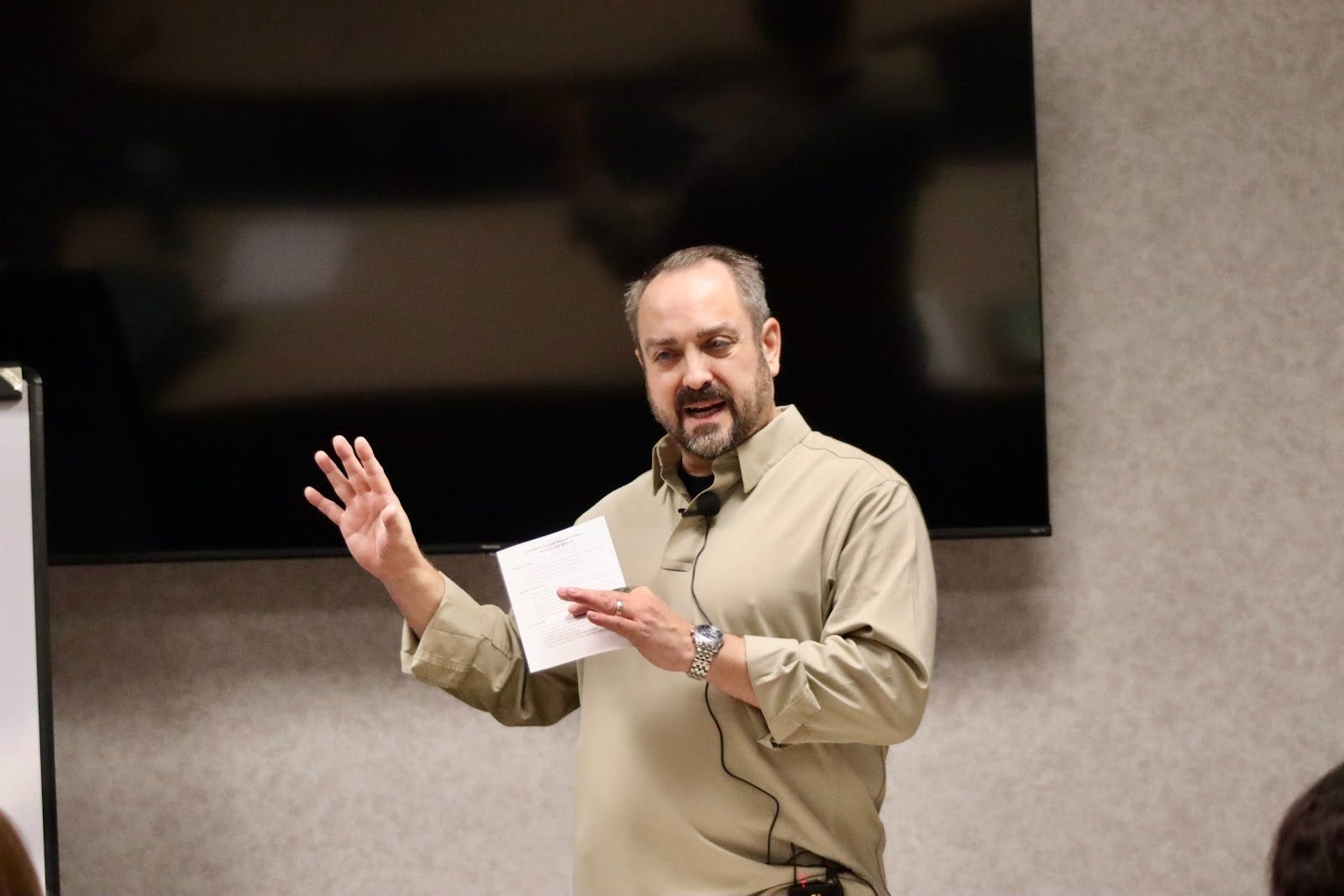
“About 300 searches take place in Wyoming alone every year,” Chris told the audience. “Most of the time we get the call because somebody’s gone out there without preparing properly.”
Preparation, Chris told us, is your greatest ally. A checklist for any outdoor excursion (wilderness or park) circulated around the room. “You need to dress properly,” he said, “synthetics and wool. Cotton will get you killed. Wear colors that stand out; royal blue is best, it doesn’t appear anywhere in nature.” We went through the list. Water, waterproofs, flashlight, bear spray, gun…
“Better a stronger back than a lighter pack,” chimed in a large man to Chris’s right, the movement of his mouth barely visible through his thick white handlebar mustache. “Your survival is your problem!” he declared with the bravado of a person already well known and admired by most of the people present. “So you need to know - how do you solve your problem?” A murmur of understanding and agreement around the room: survival is asserting your independence. The man tipped his low brown cap at Chris, a signal to continue - received and understood by the signaling master.
“Most of all,” Chris said, “You have to bring your brain with you.” Most instances of getting lost result from a snowball, not a single event. Bring your brain means: communicate your plan with someone before you go; agree check in times; plan for the worst case; don’t freak out when you get lost; stay where you are once you are lost; look for landmarks; try to signal for help - stop the snowball.
A signal must be seen and understood. How do you signal? Signal to the eye: make your sign twice as big as you. Straight lines and right angles don’t appear naturally, so they stand out. Use your brain and think of threes. Three dots, three dashes if you can, but any set of three will be recognized as a call for aid (three piles of branches, three big rocks, three fires - though if you make a fire you better not start a forest fire.) Signal to the sky: V means “Help”, X means “Medical attention required.” When a plane sees you they’ll dip their wing to let you know; don’t worry when they fly off.
Signal to the ear: if you have a radio, bring spare batteries. If you use your gun for an S.O.S., point it at the ground. Having a plastic whistle, or resourcefully using empty bullet casing, can be the difference between getting found and perishing.
Survival doesn’t cost much. $15 at Walmart can get you a long way (glow sticks, a mirror, matches, etc.) There are more expensive options, like Garmin and Apple emergency alerts. “People use that kind of stuff over in Teton County,” Chris said, “because they have the money to pay. And guess what? They don’t prepare!”
A speculative voice chimed in from the back row – heads swiveled to listen. “What happened to that climber who died on Devil’s Tower last week?” Swiveling back to Chris, eighty-odd eyes fixed on him.
“I can’t speak to that,” Chris said.
“I heard he tried to come down after dark!” another large man with a distinctive set of brown cowboy boots with a gold inlay shouted.
“No they found him in the day!” another speculator. Multiple voices started to speak at once.
“Why did they need the chopper?”
“He got the wrong ropes!”
“Where was he from?”
Chris tried to get the room back. “What I will say,” he began, “Is that he checked in with his wife when he reached the top, which is exactly what you should do. I can’t say any more about what happened on the way down.”
After a bit more back and forth, Chris began to wrap up and invited others to speak. One woman introduced herself as a teacher at the local school and, thanking Chris, the posse, and the library for hosting the event, said that they should organize a similar talk for students. “This is exactly the kind of thing this community needs,” she said.

I was struck by just how many people shared stories about getting lost in the wild, and techniques that helped get them home safely. “There’s usually some sort of trash you can use,” someone said. “I used a beer can like a mirror to signal for help.” Lots of nodding and conflicting feelings about littering.
This part of the session ran on for a while as more and more people swapped tips: pack the right kind of emergency glow sticks and beef jerky; find fish in the shallow part of the river; never explore the higher parts of the forest in winter. It was a reminder that there aren’t many forums for a community that spends so much time alone in the wilderness to get together in one room and learn from each other like this.
Eventually it was time to leave the library. Chris promised that all were welcome to reunite there the following month for the series’ third session. “Until then, I want to leave you with a book recommendation,” he said. “Surviving the Unexpected Wilderness Emergency. This is the book for survival. It’s not about collecting berries or braiding grass, it’s about common sense.”
A chorus of scribbling as people made note. Chris repeated the title. Surviving the Unexpected Wilderness Emergency. Someone asked if they have it in the library. “I’m not sure,” Chris replied, “but you should go and ask a librarian, there’s one right outside.”
~
Oliver Jakes
To read more stories from America’s public libraries, subscribe to our Substack below, visit our website, and follow us on social media.
That room is packed! Love how all ages are listening to same important and useful information
fascinating story indeed