
It’s a cold morning – a thick mist is all that remains of the horizontal rain that slashed against our tent through the night. Carmen and I are driving into Pittsburgh from the west, keeping the copper-colored Ohio River to our left. We see the first bridge: a vibrant, yellow, criss-cross steel lattice suspended above the rushing water, glowing against the gray background of the sky.
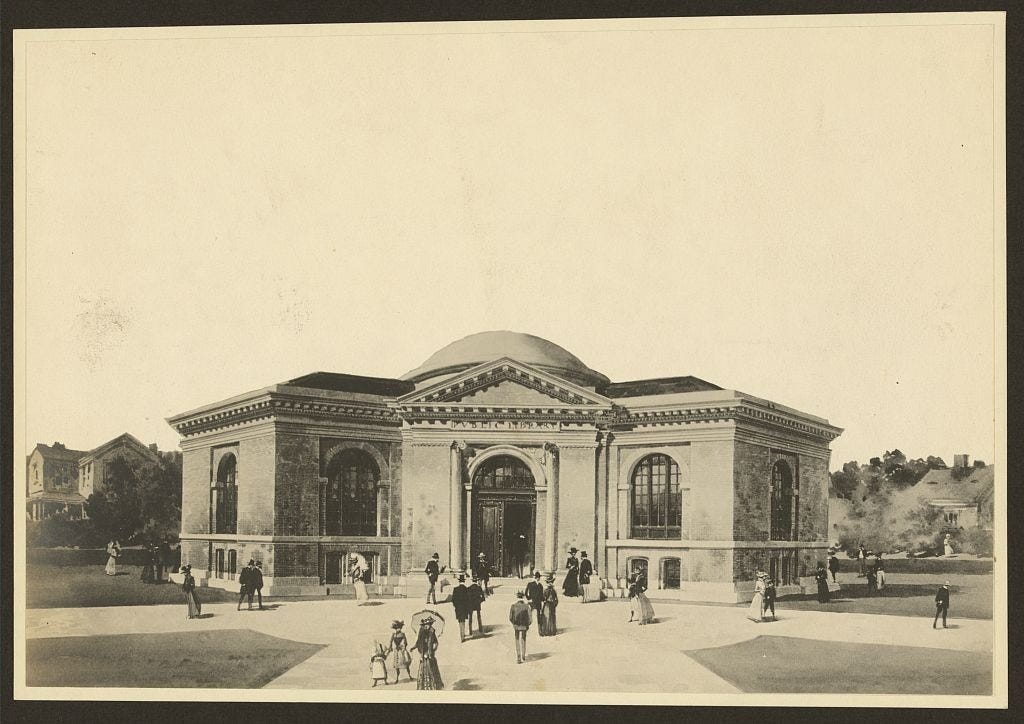
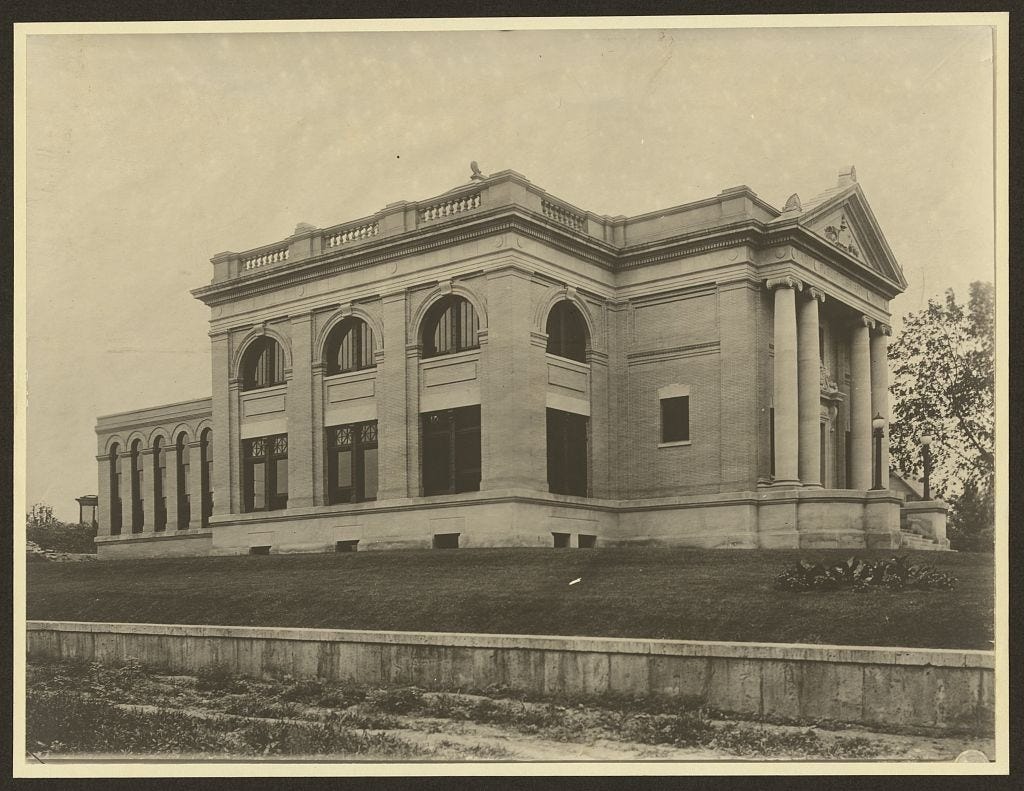
We find the Carnegie Library of Pittsburgh a few miles from the center of town in Oakland, joined with the Carnegie Institute museum and concert hall. Its grand stone walls, round arches and ornamental columns give this Renaissance-style building the feel of something between a Greek temple and an Italian bank. Above the entrance, the words “Free to the People” are carved in stone.
Andrew Carnegie, Illuminator
Born in 1835, Andrew Carnegie was a Scottish-born American industrialist who built a vast steel empire headquartered in Pittsburgh, Pennsylvania. In 1901, he sold his company for $480 million – the equivalent of around $19 billion in 2026 (or approximately 2% of the market value of Tesla). A committed philanthropist, Carnegie began paying for the development of new public libraries in the 1880s. By 1910, over 2,500 so-called “Carnegie libraries” had been created around the world, around 2,000 of which were in the United States.1
Carnegie financed his first library in 1881, in his birthplace of Dunfermline, Scotland. He had the front entrance inscribed with a quote from the Book of Genesis: “Let there be light.”2 The declaration seems like a simple metaphor: with libraries comes education, with education comes knowledge, and with knowledge comes wisdom and understanding. Perhaps, like many businessmen, Carnegie missed the irony of not-so-humbly drawing a direct parallel between himself and God, though this is purely speculative.
Historian E. P. Thompson might offer a more literal interpretation of the quote. Writing about working-class literacy in Britain, Thompson lists the cost of candles and spectacles as key barriers to social mobility. He argues that the number of hours that a working-class person could dedicate to education and reading was limited not only by the demands of their working and family lives, but by their access to illuminated spaces after dark. In other words, light was a privilege for the wealthy that sustained the education gap along class lines.3
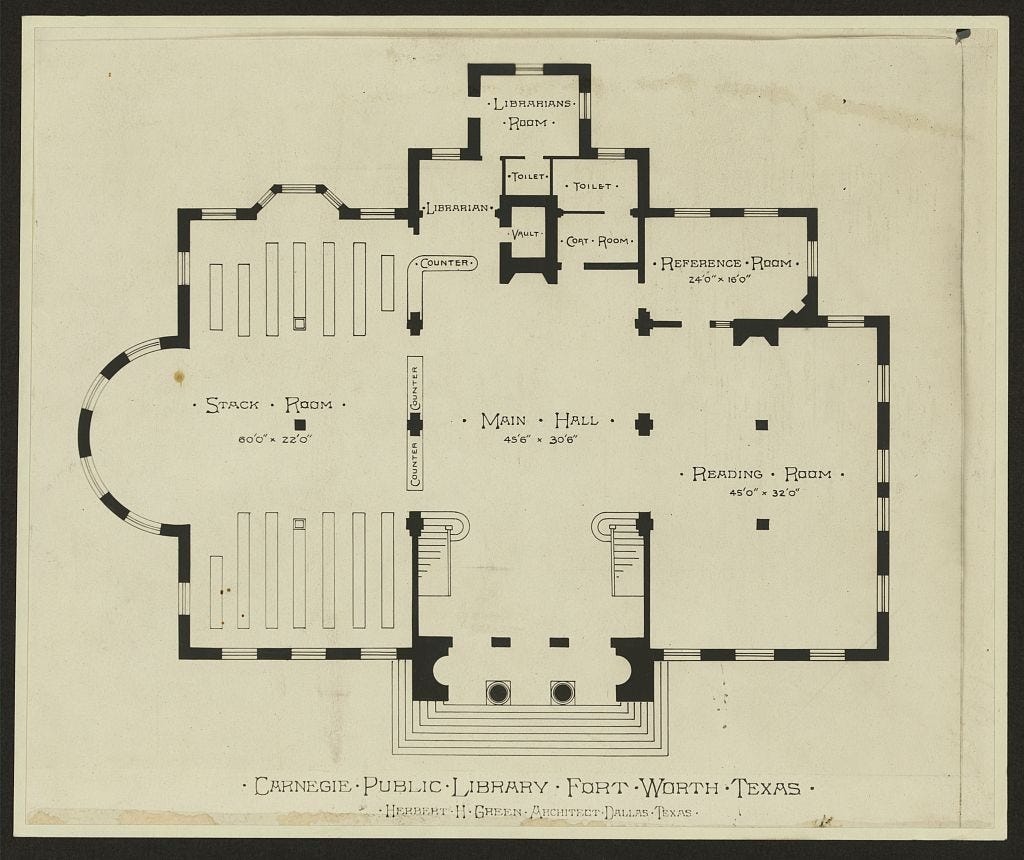
Carnegie libraries, and public libraries more generally, altered some of these conditions. They provided the lamps, books, and writing materials necessary for learning. They provided heat, chairs, and tables, particularly crucial in creating a learning environment in cold, harsh winters. They gave readers somewhere to go after work, which was especially valuable when homes were small and space was scarce, rooms were shared, or fuel was carefully rationed. In Thompson’s model, then, the offer of the library is the offer of the American Dream: By providing all citizens with equal access to resources, the library means that everybody has the same opportunity to achieve career success, financial prosperity, and upward mobility, regardless of their social background.
Cardiff University professor Oriel Prizeman describes Carnegie libraries as part of a wider change in the design of public interiors. Questions of daylight, ventilation and artificial illumination were becoming questions of civic provision and social mobility as reading rooms allowed poorer people to read after dark.
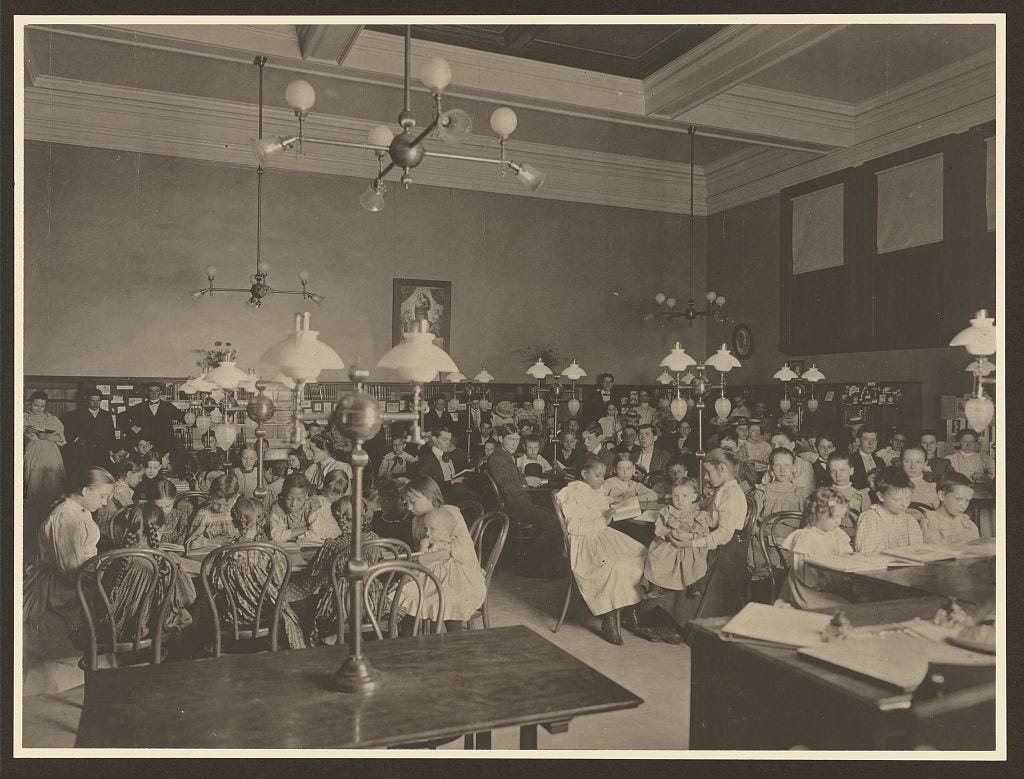
In the image at the beginning of this article, children and young adults gather in the Carnegie Library in Pittsburgh, huddled over books illuminated by natural light. Metallic chandeliers hang from the ceiling, and white lamps adorn the centre of each table. In 1899, this library created the first fully developed children’s department at a public library in the United States. In doing so, it brought education, information, and community participation that were essential to providing opportunities to the lower classes.
Andrew Carnegie: Let there be light?
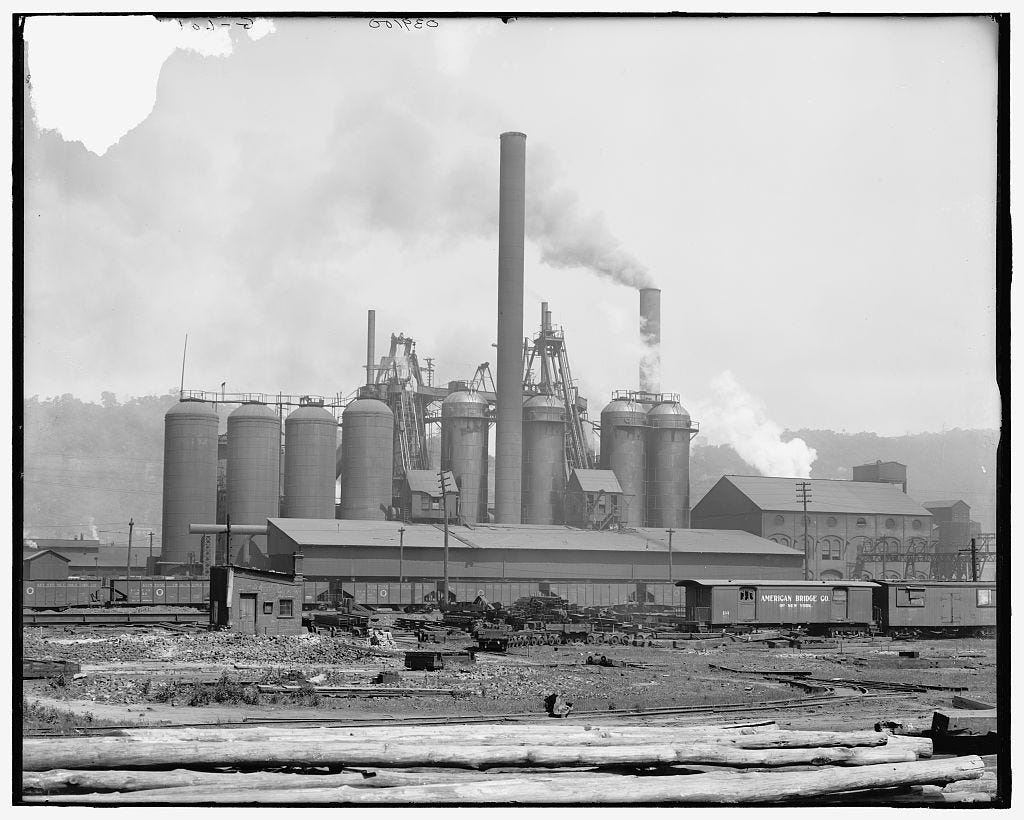
But we must understand the nature of Carnegie’s industry to truly understand his gift of light. The Carnegie Steel Company was known for the record-breaking rates of production boasted by its mills. With this record production came industrial-scale consumption, as the steel mills pumped pollutants into the atmosphere for decades. These included sulfur dioxide, nitrogen oxide, particulate matter, and non-methane volatile organic compounds.4 Four of the company’s steel mills were situated within the Pittsburgh area, clouding the sky above the river that we drive by over a century later.
At its height, one of the larger mills, known as “The Lucy Furnace,” produced 100 tons of pig iron (a crude, highly brittle intermediate metal with very high carbon content, produced by smelting iron ore in a blast furnace) per day, achieved through the relentless “hard driving” (using the mills at maximum intensity, such that production actively damages the apparatus) of machinery and workers, which required the mill to produce twice as much steam as the average steel mill of the late nineteenth century.5
Working in a blast furnace posed immense risks to laborers: In August 1877, seven workers were repairing the interior lining of a furnace at the Lucy site when their scaffolding collapsed. They plunged around 40 feet onto a burning “clinker” (an extremely hot, solid chunk of fused material at the bottom of the furnace) below. Four died, and three were severely wounded.6 In 1892, mill workers went on strike against these poor working conditions, but were quickly defeated.7
It should also be noted that by the 1890s, the Carnegie Steel Company was employing some 40,000 men.8 The company created jobs, generated wealth, and turned Pittsburgh into the steel capital of the world. Carnegie gave away approximately 90% of his fortune; he invested in local arts and culture, higher education, and a range of charities on top of the Carnegie libraries.
The Carnegie Library today
So, what are we to make of Carnegie’s philanthropy? This question is on both of our minds as we pass below the “Free to the People” sign and enter the library, seeking out the main reading room. The polished wooden desks are busy: The sound of click-clacking keyboards ricochets off the room’s long white walls and high, domed ceiling. I see an older gentleman in a short-sleeved white shirt, attacking a page with a pencil; it is unclear whether he is sketching or writing furiously.
Carmen joins a group of around a dozen people who have gathered in a side room for an English-speaking hour aimed at community members who are learning English. She meets Modina, who had arrived from Kazakhstan three weeks earlier. Modina tells her that she moved to Pittsburgh because of her husband’s work and had already attended three sessions. It has been helpful, she says, to get out of the house. The library gives her somewhere to meet people – she’s already made one friend, who moved here from Mexico.
Another woman, Gladys, has lived in Pittsburgh for a year. She has been coming to the library for most of that time. The English group offers her what she describes as a “safe space” to speak without judgment.
In another room, I attend a lecture on Pittsburgh libraries and legal resources, given by a representative from the Allegheny County Law Library. The point of the session is to clarify exactly what a library can and cannot do to assist the public when they become entangled with the law or the courts. Librarians can direct people toward legal materials, forms, and research; they cannot provide legal advice.
Two people ask how someone from a low-income background might obtain representation. Another asks how to write a will. The representative refers them to the self-help collection of legal materials available at Allegheny County Law Library and the Carnegie Library itself, and says that an earlier session dealt with wills in more detail. He then explains how a person can apply to proceed in forma pauperis when they cannot afford court filing fees.
When legal procedures seem opaque, the library can act as a clarifying resource. Librarians can illuminate legal processes, but they absolutely cannot participate in them on someone else’s behalf. Some of the members of the audience found this distinction frustrating: “I expected help, not just information on forms and terms,” one woman says. “When you’re in my position, you don’t want money – you just want justice.”
I think about Carnegie libraries and justice. These remarkable spaces are, without a doubt, engines of social mobility, community formation, and education. I think about the scribbling man in the white shirt and wonder how many great works of literature have been written within these walls by Pittsburgh-based writers like Pulitzer Prize-winning authors Annie Dillard and David McCullough. But Carnegie libraries aren’t truly free. Born out of America’s dependence on philanthropy for welfare infrastructure, they have hidden costs to people and the planet.
As we continue east from Pittsburgh, we have more questions than answers. How do we reconcile philanthropy with destruction? Is it fair to apply modern terms like “whitewashing” to historical actors? Who should be responsible for protecting and developing libraries, and what values should they promote? I can’t help fearing that the future of any public service that depends on the whims of the wealthy will always be unclear; when we give away the power to turn on the lights, we shouldn’t be surprised to find ourselves in the dark.
~
Oliver Jakes
Susan Stamberg, ‘How Andrew Carnegie turned his fortune into a Library’, NPR (1 August 2013), <https://www.npr.org/2013/08/01/207272849/how-andrew-carnegie-turned-his-fortune-into-a-library-legacy> [accessed 28 July 2026].
See Andrew Carnegie Birthplace Museum, ‘Carnegie Ex Libris’, <https://www.carnegiebirthplace.com/blog/2020/11/10/carnegie-ex-libris-book-week-scotland> [accessed 28 July 2026].
Oriel Prizeman, Philanthropy and light: Carnegie libraries and the advent of transatlantic standards for public space (London: Routlegde, 2016), pp. 1-2.
See Ali Hasanbeigi, Navdeep Bhadbhade, Ahana Ghosh, ‘Air Pollution from Global Steel Industry’, Global Efficiency Intelligence <https://www.globalefficiencyintel.com/air-pollution-from-global-steel-industry> [accessed 29 July 2026].

This accident was reported in St. Paul Pioneer Press, Volume 23, Number 184, 4 August 1877 <https://newspaperhub.mnhs.org/?a=d&d=sppp18770804.1.2&e=-------en-20--1--img-txIN-------------> [accessed 29 July 2026].
Washington State University, ‘Andrew Carnegie’, <http://digitalexhibits.libraries.wsu.edu/exhibits/show/2016sphist417/anton-grose-supreme-court-juri/andrew-carnegie> [accessed 04 August 2026].
Washington State, ‘Carnegie’.
very illustrative and genuine
Oliver and Carmen keep giving us more questions than answers but what an eloquent challenge to think hard about our country they offer in this last paragraph! It’s really investigative journalism at the highest level and deserves wide distribution.
Read Ezra Klein’s op-ed in The NY Times today on what’s relevant to our war torn nation in “The Odyssey”.
Dennis Dalton