
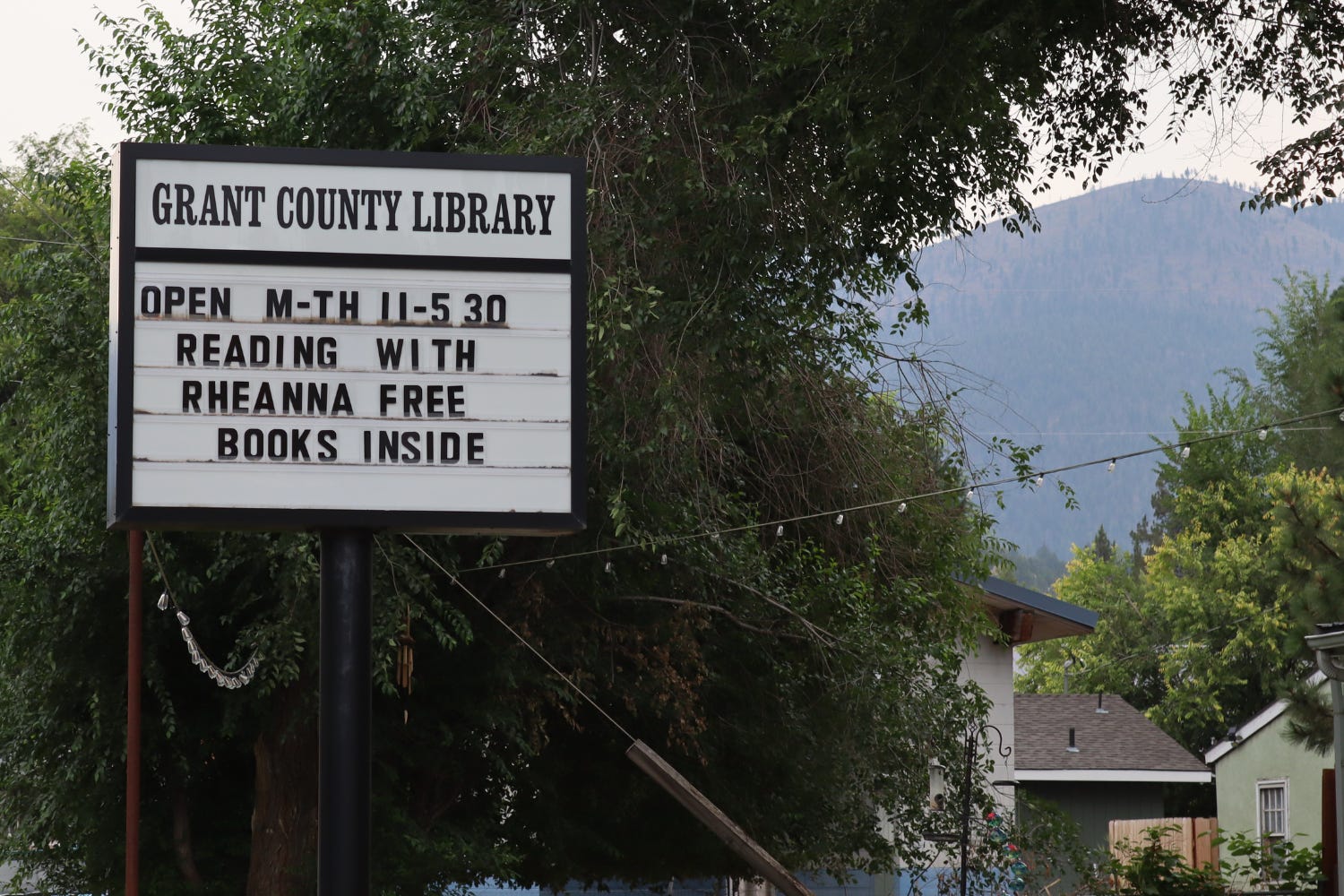
In June this year, the people of John Day, Oregon, gathered in a crowded community hall to fight for their library. Facing a $1.5 million budget shortfall, Grant County officials had announced plans to close the Grant County Library – one of the last public spaces in John Day. Nearly 200 of the town’s 1,500 residents turned up to testify, from a nine-year-old girl who had read over 90 Warrior Cats novels to a group of retirees who found friendship through the library’s walking group.1 Each speaker returned to the same painful truth: this community has already lost too much.
Two months later, Carmen and I started our journey across America, library by library – beginning with a five-hour drive east from Portland to John Day. According to Carmen, the drive wove through spectacular Oregonian scenes: pine forests swept into sagebrush plains; grasslands bumped up against potato fields; and Mt. Hood witnessed it all. I remember almost none of this. It was my first time driving on the right side of the road, so my eyes were glued to the asphalt. Much to our joy (and my surprise), we made it safely to the Ochoco National Forest, where we followed a series of narrow service roads to our first campsite.
Our alarm was set for 7:30 a.m., but the summer sun poking through the branches of the towering Ponderosa pines insisted on an earlier start. Two bowls of porridge later, we loaded the car and prepared to set off. But deep within the forest, Google Maps had no idea where on Earth we were, never mind where John Day was. No service. Argh! We were a couple of unprepared city slickers gawking at our loading-page gray matrix map. Eventually we agreed on a direction and took our trusty Volkswagen Tiguan (Carmen’s family car) down a steep gravel path until we found the highway and drove east, following signs to John Day.
The road took us into the John Day River Valley, where we found the town enclosed by basin walls dotted with juniper trees. John Day is built around the intersection of two highways (routes 26 and 395). It is small and quiet; there are a handful of motels, stores and restaurants and a few side streets lined with low white houses.
Despite our misadventure, we had trundled into town and parked by 10 a.m. With the library closed until noon, we set out to explore John Day on foot. We already knew about the County Court proceedings and the threat that the library was facing, but we wanted to get a feel for the town to better understand the library’s role in the community.
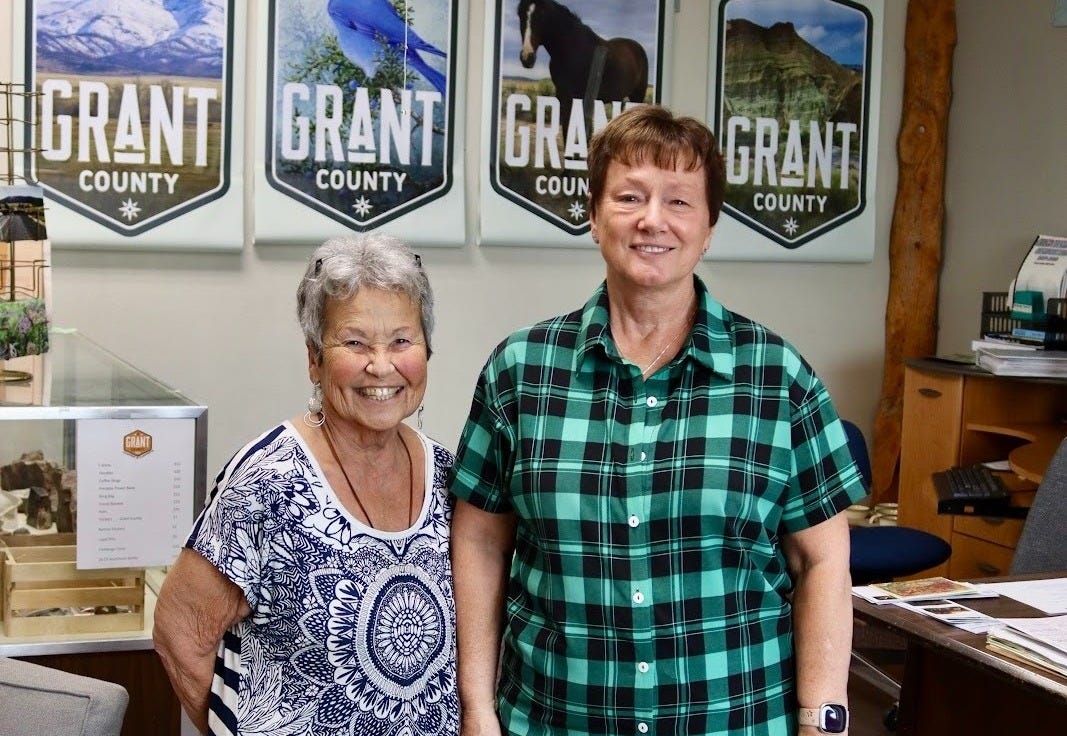
Our stroll began with a stop at the Grant County Visitors Center. A bell jingled as we walked through the door.
“Can I help you?” asked a woman working at her desk. We stumbled over a short summary of our project (we were yet to perfect the elevator pitch this early in our trip) and asked her if she had time to talk to us about the town. “Of course!” she replied warmly, introducing herself as Tammy. “What do you want to know?”
Tammy told us that John Day was founded during the Gold Rush in the 1800s. People from around the world, particularly China, immigrated to the area in hopes of striking it rich. Later, when the gold ran out, it became a logging town. Tammy’s father moved to John Day to work for one of its many lumber mills, until spotted owl nests were discovered in the forests during the early 2000s. Spotted owls are protected under the Endangered Species Act of 1973, so almost all logging ceased immediately and a large proportion of the workforce was laid off. Last year the town’s final lumber mill, Malheur Lumber Co., announced that it would be closing down, leaving the area’s last 76 loggers without work.2 Neither the state nor federal government invested in retraining laborers or cultivating other forms of industry in the area, so the town no longer has any real industry and has seen its population steadily decline. The largest employers are now the grocery store (Chester’s), the local public schools and the government.
The bell jingled again and a short woman in a black-and-white floral dress came bustling in. Without pausing, she flung her bag down and started to organize a set of boxes that had been pushed against the back wall.
“That’s the mayor,” Tammy said, casually.
“I’m Sherrie!” the woman announced with a smile, crossing the room to greet us with two masterful, mayoral handshakes.
We explained the project again, this time slightly more succinctly. Mayor Sherrie sighed, and told us that the library is so special to the community, but it is going to be difficult to save it. “The townspeople were given two options,” she said. “Increase taxes for everyone through a bond and a levy, or create a new tax district – that would mean that a new geographic region could be created to pay tax towards keeping the library open, rather than the entire county.” At that moment, Sherrie and Tammy couldn’t tell us how realistic they felt that either option was.
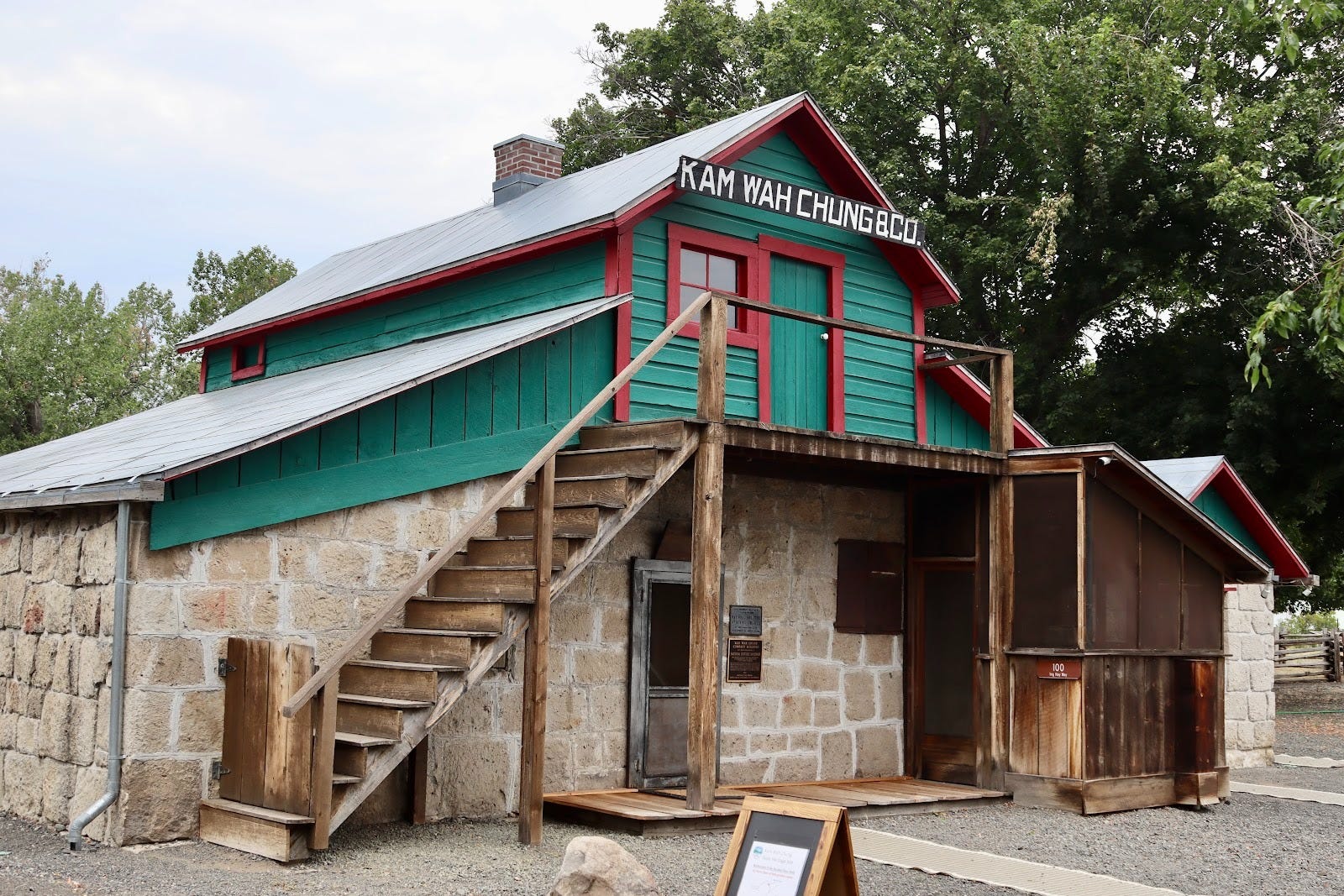
We thanked Tammy and Sherrie for their time and continued walking up the main road until we arrived at a museum called Kam Wah Chung, a Gold Rush-era Chinese apothecary and merchant’s home. There, we spoke to Rowan – a Park Ranger here for the summer – who gave us a tour of the small building, which was built in 1865. Kam Wah Chung was home to a businessman named Lung On and a practitioner of herbal medicine named Ing “Doc” Hay. The building served as a social, medical, and religious center for Oregon’s Chinese community, and the greater John Day community, for over 60 years.3
Rowan paused at the door before we entered. He pointed to a dusty plot of land next to Kam Wah Chung contained by a low, square wooden fence. “This used to be John Day’s Chinatown,” Rowan said, “one of the largest in Oregon.” Survived only by this small stone building, it was hard to imagine the bustling community of workers that once lived here. Rowan told us that the plot had since housed a community swimming pool, but it had been filled in a few years ago when local funding dried up.
Leaving Kam Wah Chung, Carmen and I spoke about the sense of loss in John Day: the once bustling Chinatown and roaring sawmills had left almost no trace and the community pool was gone. We wondered, what do the people of John Day still have? What holds a town together? With these questions in mind, we arrived at Grant County Library.
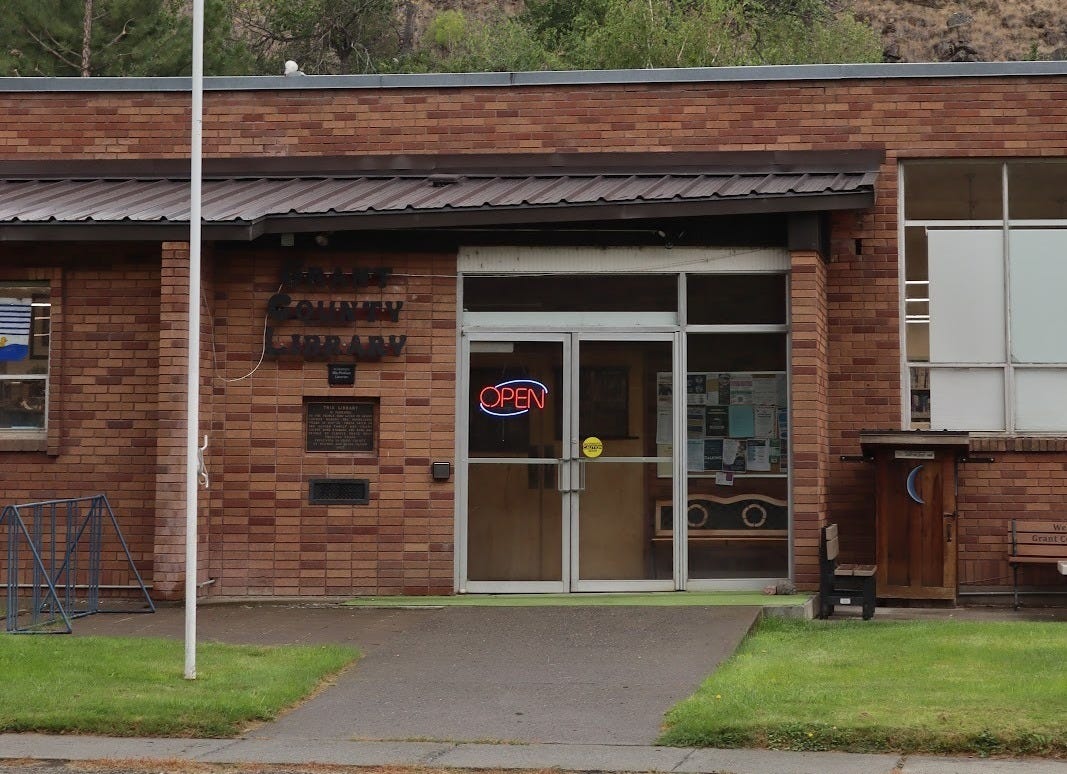
The building was an unassuming, single-story brick structure with a neon red ‘OPEN’ sign on the door. Outside, the Star-Spangled Banner flew proudly above a cluster of wooden benches engraved with ‘Welcome To Grant County Library’.
Inside was cozy, friendly and calm. Library Director Chris Osberg greeted us casually from the help desk at the center of the room. We spoke a little and looked around.
Most of the library fit into one main room with high bookshelves and tall windows. Adult fiction was the largest section, boasting a large shelf dedicated entirely to Louis L’Amour Western novels, which Chris later told us were some of the library’s most popular books. The children’s section was clearly marked by a large, colorful rug and a LEGO street on top of one of the bookshelves.
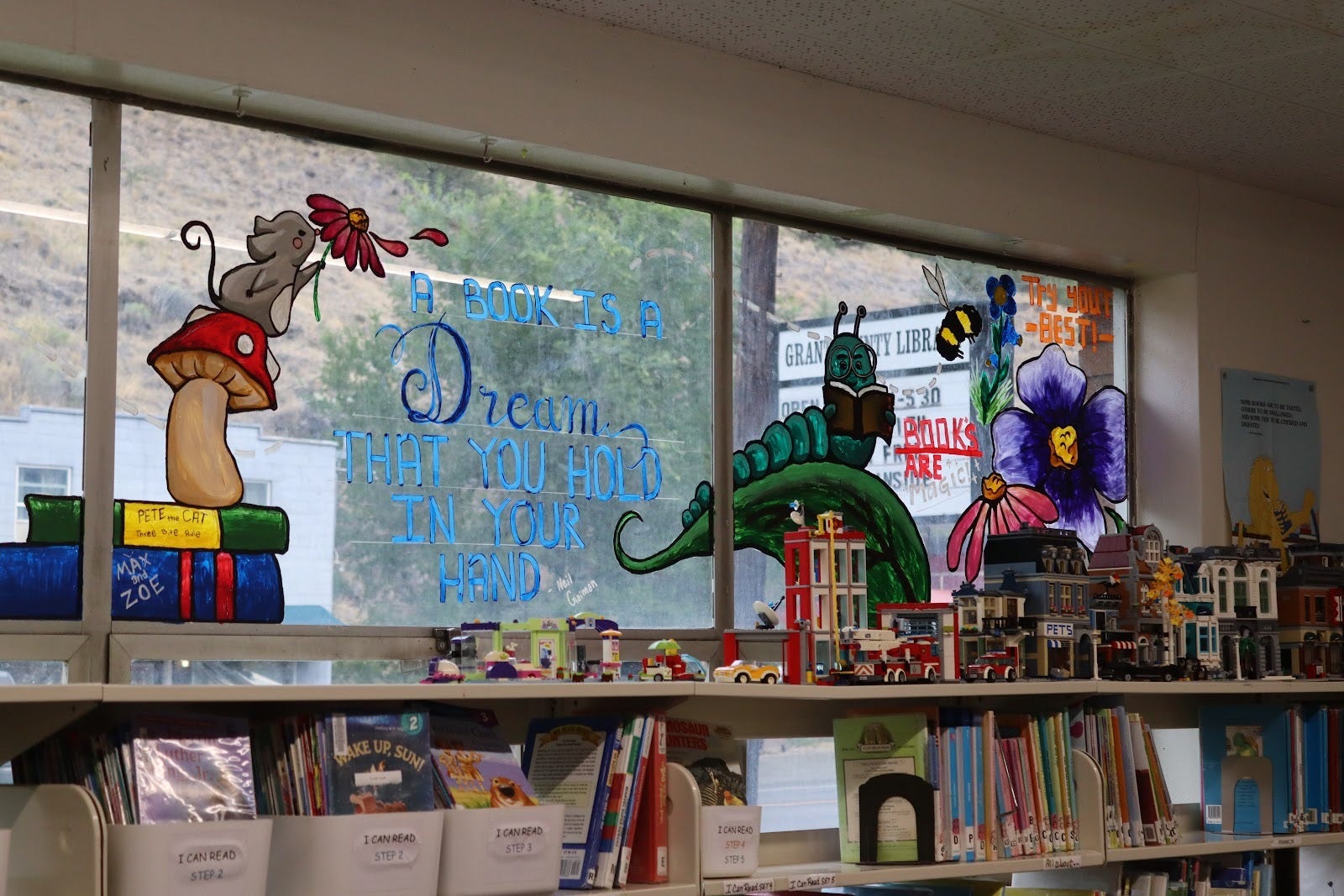
Every few minutes someone new entered the building. Familiar hellos and how-are-yous were exchanged as people chatted with Chris before picking up and dropping off various books. A mother brought three young children to sit quietly in the children’s section. An older man came in and used the computer, printed something and left.
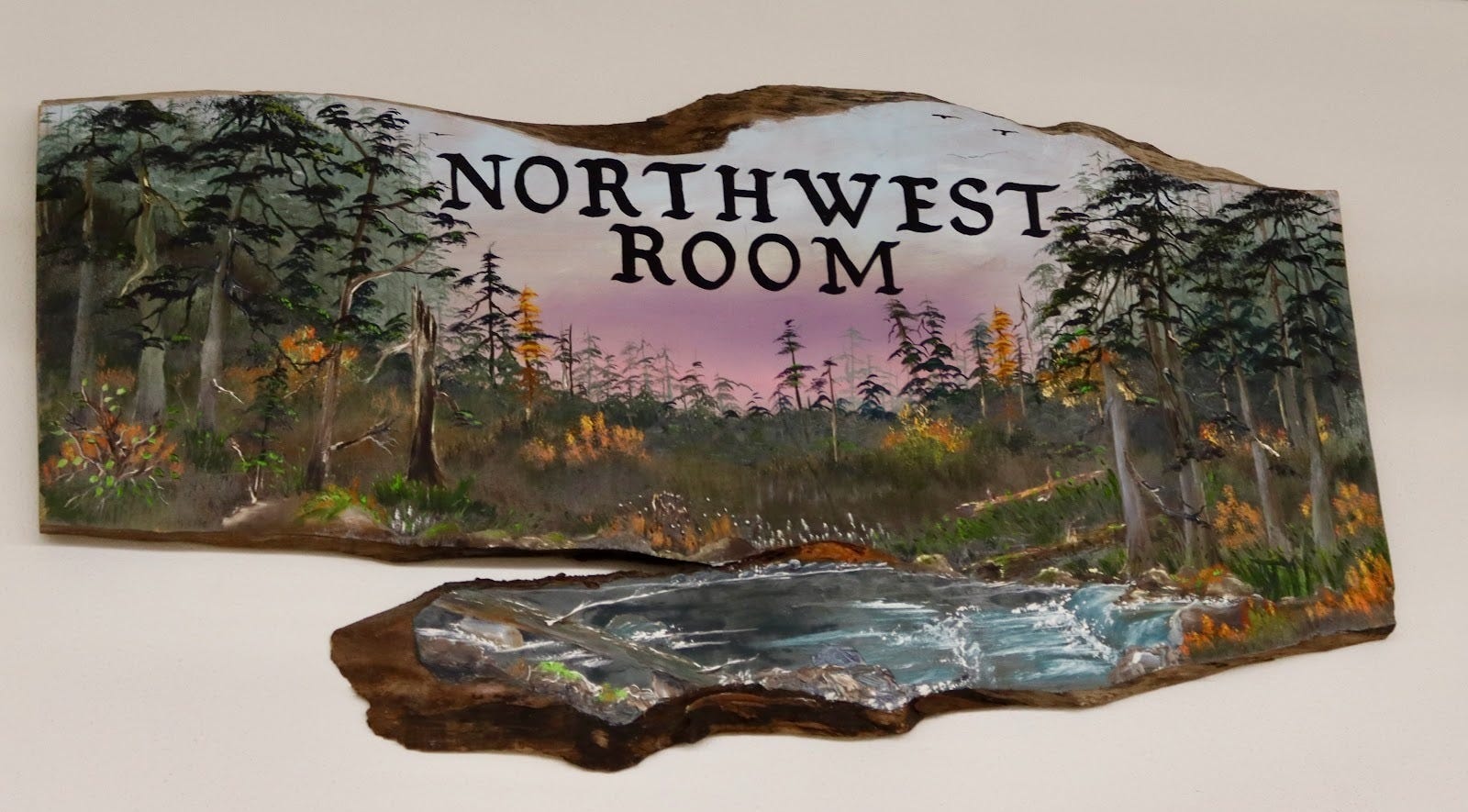
At the back of the building, a pinkish painting of a forest at dawn hung over an open door. ‘Northwest Room’ was written in the sky. The room contained an archive of local newspapers from 1926 to the present and books detailing the local history, ranging from field guides and geological maps to novels written by local authors. According to Chris, the room is mostly used by local historians, but she has also had a lot of people visit the library to learn more about long-lost uncles and great-grandparents who had almost been forgotten.
Chris has lived in John Day since she was a child. She started working at Grant County Library 18 years ago, and has been the Library Director for three years.
“Growing up, this library was a place that I could always go to get a new adventure,” she said as we pulled our chairs out and took a seat around a table. “It has always been a place where I could stop in and talk to friends. This is the only place in the county where everyone is happy to go. You can meet a lot of people when you go to the grocery store, but you have to pay for groceries. You go to the library, everybody is happy to be there. You come in, you get a story, you get a movie. It’s a happy place for the community.”
Chris explained that internet access is one of the library’s most essential services. “We are in the middle of the county and the middle of the state,” she said. “There isn’t a whole lot of Wi-Fi and there’s even less phone service.”
In Oregon, access to broadband is often cut along social and urban lines. While just over 50% of Grant County has broadband, almost 98.7% of Multnomah County (which contains Portland) has high-speed coverage.4 By offering free, 24/7 access to the internet, the library helps bridge this digital divide. It is the place where anyone can go online to apply for a job, file taxes, or reach their doctor, no matter what’s available at home. Grant County Library is the only source of free Wi-Fi in John Day or the neighboring Canyon City – a town that is only half the size.
Chris chuckled. “I had a gentleman once whose credit card suddenly got stopped,” she said. “He lives out in Monument, 40 miles from here. His Starlink went down and he couldn’t get it restarted because he had no internet. He had to drive all the way here to use our Wi-Fi.”
“We’re also right between the high school and John Day,” she added. “So all the kids walking home stop here. They’ll sit down, use their phones and talk for a bit, which gives them a safe space to be together where they can connect to the world beyond our little town.”
Chris and her assistant librarian, Dovie Wood, give the community far more than books or computers. “All libraries help in every aspect they can,” Chris said. “I’ve helped people set up their telephones. Because we’re so remote, you can’t just go to a Verizon store. You do it here — sit at a computer for four hours and we’ll walk you through it.”
Her examples tumbled out in a rhythm of rural pragmatism: “We help people make flyers. We tell newcomers what’s going on, what’s fun to do around here. I even proctored an exam for a college student so he could stay in town and still go hunting with his family. Out here, you can’t drive back and forth to Portland. You make things work locally — that’s what we do.”
The library itself, she explained, has always been rooted in that same spirit of practicality and generosity. “This library started in 1902 in the basement of city hall,” Chris said. “They had a budget of $150. This building was put up in 1962 by a rancher named Herman Oliver — he donated it to the county. He was really community-minded.”
That tradition continues in small but thoughtful ways. “We’re starting a ‘library of things,’” she said. “Stuff you’d use once — a chocolate fountain for a party, a dehydrator for apples. You borrow it, use it, clean it, and bring it back. I even lent a CD player to the hospital hospice once, because a patient couldn’t sleep. We sent the player and some audiobooks. Now he can rest. We just try to help, no matter what it is.”
Children, she said, are at the heart of that effort. “There’s not much for kids to do here. We lost the swimming pool. Now, this is one of the safest places they can come — to play games, read, hang out. My main goal is that they’re safe and that they walk out with good memories.”
When we asked about her colleague, Chris smiled. “Dovie and I make a good team,” she said. “She grew up here, she knows everyone. She’s got the heart for it.”
Dovie, who joined the library four years ago after a long career in the school system, laughed when we asked what had surprised her most. “I thought, I’ll finish my career at the library — how hard can it be? Just check out books, right? I was wrong. We’re busy. I was one of those people who didn’t really know what the library does. I was sadly mistaken.”
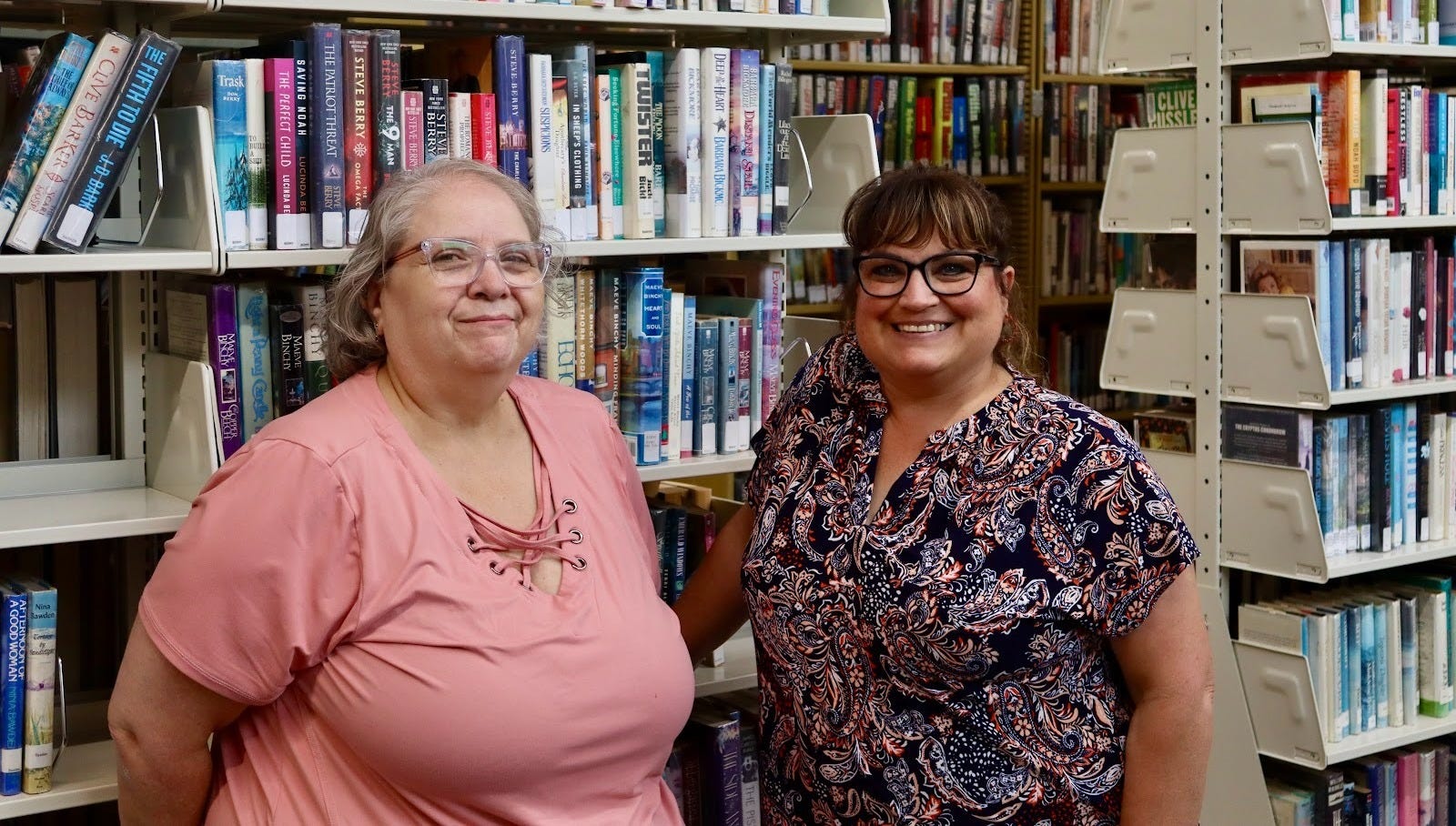
Dovie quickly discovered that much of the job is about people, not the Dewey Decimal System. “We have folks who come in just to visit,” she said. “They’ll say, ‘We didn’t need anything, we just wanted to see you ladies.’ They talk about their kids, their grandkids. We’re part of their routine. We’re their connection. For some, we’re the only people they speak to all week. I feel like we are a family.”
“There’s a gentleman who lives up in the mountains — no electricity, no family,” Dovie explained. “He comes to town once a week for groceries and to visit us. Chris always tells him, ‘If you don’t come in, you have to call.’ If he doesn’t, we phone him. Because who else is going to check in?”
The library also helps to fill educational gaps. “The high school took out their library — it’s down to one shelf,” Dovie said. “Now they’re planning to bring English classes here twice a month.”
Then there are the town’s voracious readers. “Some people only come to town for new books,” Dovie said. “I told my husband, if I lose my job, I’ll still get books for them — even on my day off. I’ll drive to Burns or Baker every couple of weeks, pick them up and bring them back. They check out ten books a week sometimes. They’re serious readers. They can’t even access e-books on Libby without a library card; if the library closes they won’t be able to read for free online.”
We asked Dovie to tell us about any particular patrons she has seen the library have an impact on. “When I first started, there was a young man who always sat outside using the Wi-Fi,” she said. “He was homeschooled and had a stutter, so he didn’t get much interaction. Chris knew him well. Over time he started talking to me too — first just a few words, then more. We encouraged him to say hello to other people that came in and to start conversations with them. Eventually he did. Then he disappeared for nine months. And just the other day he came back. We both had tears in our eyes. He’s so much more confident now. He actually came over and hugged me, which I couldn’t have imagined when we first met.”
Dovie sighed as she told us that without a library there is no reason left for people to stay in John Day. “My son and his wife just moved back here with their four girls,” she said. “At the meeting the other night she told everyone, ‘We wouldn’t have moved here if we’d known there wasn’t going to be a library.’ And she has two sets of grandparents who live here! People are serious about this library. They won’t live in a town without one.”
She looked around the room. “We are so much more than books,” she said simply. “That’s what worries me.”
The second public hearing on the proposed defunding of Grant County Library took place on October 21. Members of the Save Our Library Committee and the wider community gave another round of testimonies. The Blue Mountain Eagle quoted one man saying of the library, “It’s not a luxury, it’s a lifeline.”5
Next May, County residents will decide whether they will accept a levy, a new taxing district, or neither. Thanks to the efforts of the Save Our Library Committee, Grant County Judge Jim Hamsher has announced that $200,000 of Title III child education funds could be made available to support the library. But with federal support subject to change, the future of Grant County Library remains uncertain.
Oliver Jakes
To read more stories from America’s public libraries, subscribe to our Substack below, visit our website and follow us on social media.
Justin Davis, ‘Message clear after first hearing: Keep the Grant County Library’, Blue Mountain Eagle (July 25, 2025), <https://bluemountaineagle.com/2025/07/25/message-clear-after-first-hearing-keep-the-grant-county-library/>.
See Bennett Hall, ‘Malheur Lumber is Closing Permanently’, Blue Mountain Eagle (July 23, 2024), <https://bluemountaineagle.com/2024/07/23/malheur-lumber-is-closing-permanently/>.
‘Kam Wah Chung’, Oregon State Parks, <https://stateparks.oregon.gov/index.cfm?do=park.profile&parkId=5>.
‘Internet Service Providers in Oregon’, Broadbandnow, <https://broadbandnow.com/Oregon>.
Justin Davis, ‘Crowd packs final hearing on funding the Grant County Library’, Blue Mountain Eagle (October 22, 2025), <https://bluemountaineagle.com/2025/10/22/crowd-again-packs-final-hearing-for/>.