
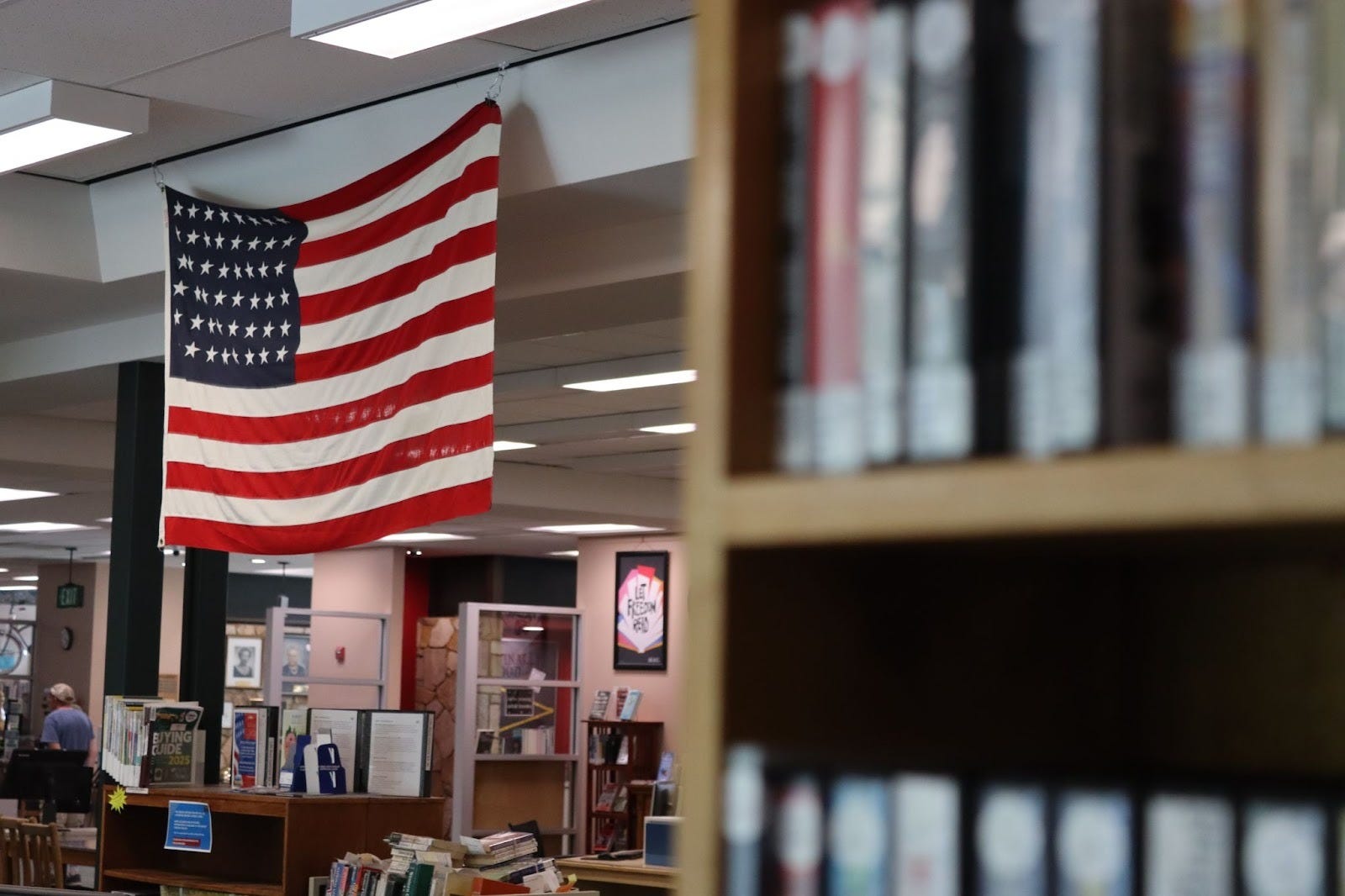
When we met Wanda, she was softly whittling away the scuffs and imperfections on an old book’s fragile spine with a square of sandpaper. A large American flag hung from the ceiling above her head. Wanda has been a volunteer at Baker County Library in Baker City, Oregon for as long as she can remember. Her job is to repair and discard damaged and old library books. “A library is like a garden,” she told Ollie and me as we sat around a wide wooden table, “you have to weed it.”
Which books should be weeded and which should be allowed to flourish? In Oregon, where libraries are facing record-high requests to have books removed from their shelves, this question is not only being asked when books are damaged or old.1 Increasingly, Oregon’s libraries are receiving demands to remove books from their collections because of cultural or moral content that challengers disagree with.2 This trend is not unique to Oregon: book challenges across America have risen to unprecedented levels in the past few years.3 Many of the disputes are about what books should be accessible to children, and what counts as explicit or obscene content. Often, “pornography” is conflated with LGBTQ+ content.4
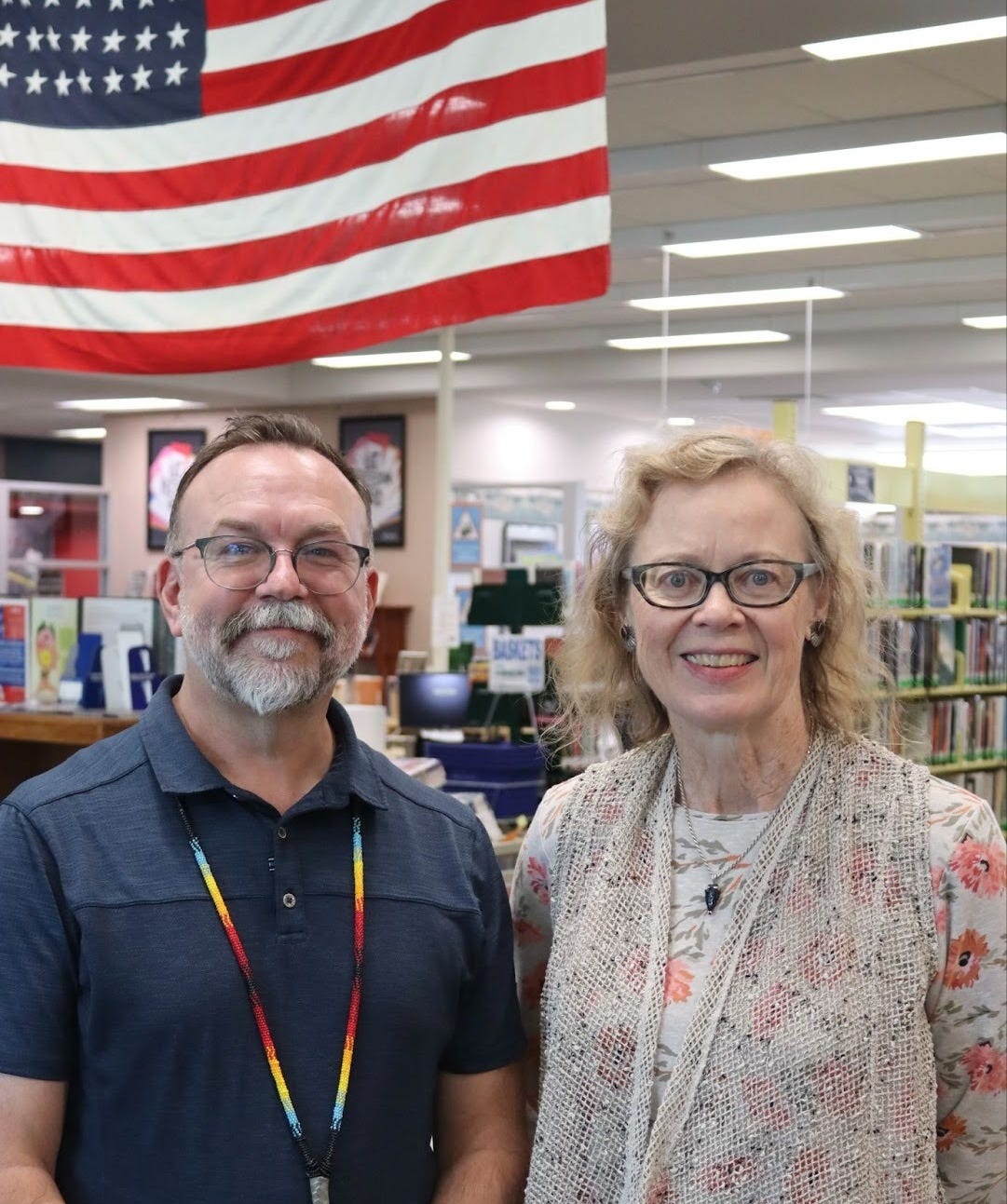
Perry Stokes, Baker County’s Library Director of seven years, had a friendly but cautious air about him when he sat down with us to talk about the climate of censorship in Oregon. “There haven’t been any formal challenges here in Baker yet,” Perry assured us. “People in Baker City are generally supportive of our freedom-to-read policies,” he said. But stories of book challenges at libraries in neighboring counties and in the local public high school have sparked concern that book challenges in Baker City could be imminent.
But Baker County Library has prepared a rigorous process for challenges if they come. Baker County residents who want to request the removal of library material have to fill out a four-page form. The first step on the form is to have an informal discussion with Perry. “Most people just want to be heard,” he said, “many issues can be resolved with a simple conversation.” But when it can’t be, the challenger must complete an extensive form asking, among other questions: Have you read the material? What do you believe is the intended message of the material? What alternate material do you recommend that represents the viewpoint of this material in a “better way”? Why should an adult library patron who disagrees with your viewpoint accept the removal you are requesting? The form ends with a value assessment that asks challengers whether they agree or disagree that, for example, “young people deserve to see themselves reflected in a library’s books.”5
On top of a paperwork barrier, Perry is taking other bold precautionary steps to fortify the library against potential attacks on its ability to defend the freedom to read. Perry is serious when he says that he believes that “the library should have something to offend everyone.” As soon as he learns that a new controversial book has been published, like He Is He or She Is She (children’s books that affirm Christian ideas of heteronormative biological sex), he buys them for the collection to put alongside other books that represent more progressive views on gender. “I think of these books as our shields,” Perry explained. “This way people can’t complain that we are advancing a one-sided agenda,” he said, adding, “books don’t take themselves off the shelves and open up their pages, people do.”
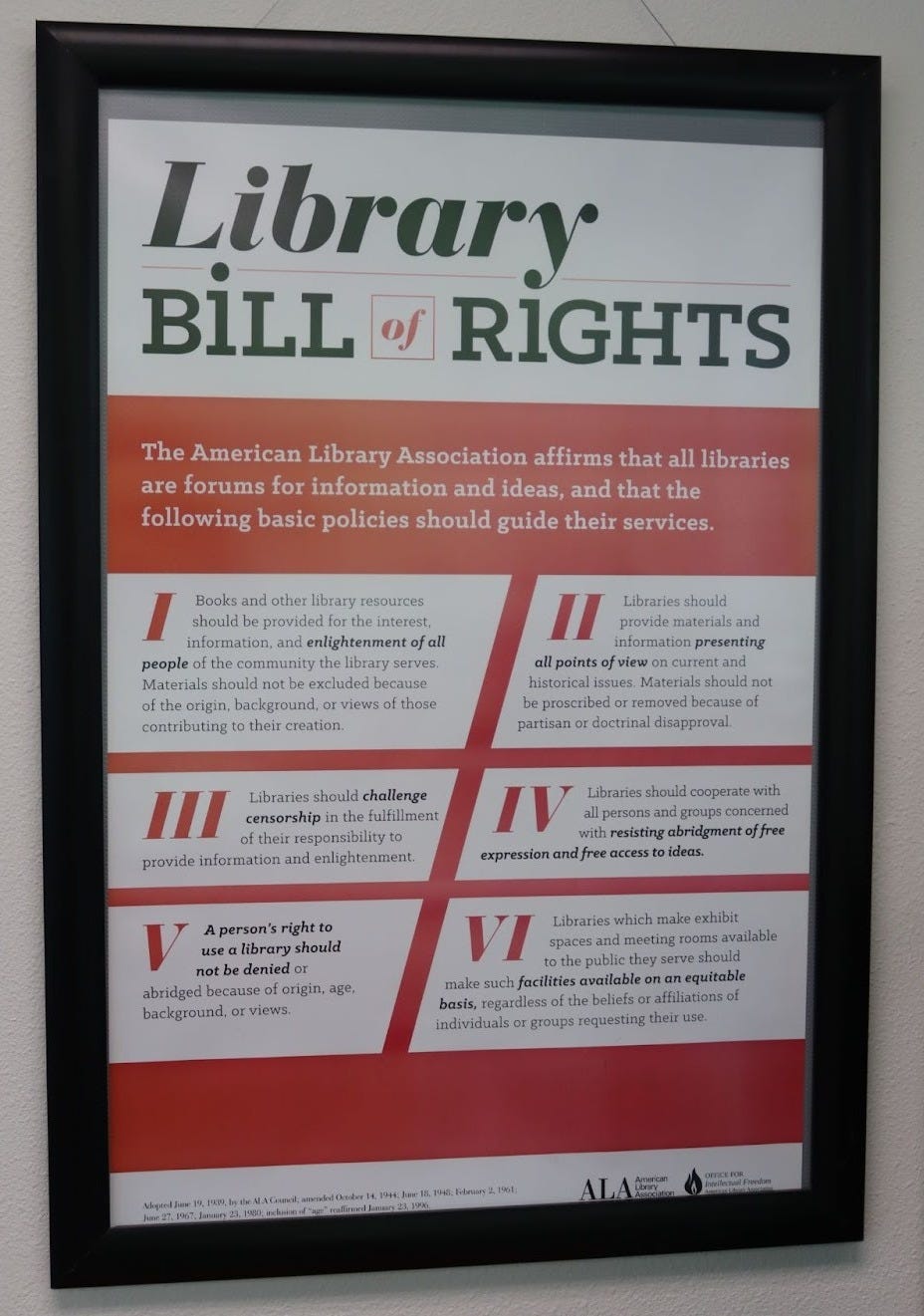
Perry’s outspoken support of free speech is written on the library’s walls. One wall proudly displays a poster of the First Amendment, and another exhibits the American Library Association’s declaration of the so-called “Library Bill of Rights”, which lists the seven fundamental policies that all libraries should adhere to. The phrases “enlightenment for all people,” “presenting all points of view” and “resisting abridgment of free expression and free access to ideas” jump out in bold.
While many community members have expressed their support for the library’s anti-censorship stance, several recent comments on the library’s Facebook page have been more disapproving. Earlier in August, Baker County Library posted a routine announcement listing some of the new additions to their children’s collection.6 The post highlighted Soar by Joan Bauer (a young baseball player undergoes heart surgery and decides to become a coach), Better With Butter by Victoria Piontek (a girl with anxiety finds companionship with an emotional support animal), Athlete is Agender by Katherine Locke and Nicole Melleby (true stories about queer athletes), Asha and the Spirit Bird by Jasbinder Bilan (a young girl journeys to find her father in India), Ellen Outside the Lines by A.J. Sass (a young autistic Jewish child reflects on gender identity) and Marijuana (Facts and Fiction about Drugs) by Clara Maccarald (reports the dangers and possible benefits of marijuana).
Three mothers posted strong reactions. Candis Snider Lee wrote, “Shame on you, Baker County Library for not providing, at the bare minimum, alternative conservative opportunities for children and their parents. A one sided conversation is indoctrination.” Sharina Connor (whose profile notably suggests she does not live in Baker County) added, “This looks like a horror show. [...] Why are librarians and children’s authors so determined to introduce sexual themes to children?” It is unclear precisely what “sexual themes” are contained in the six new books. Although these mothers have no apparent affiliation, their tone echoes that of Moms for Liberty, a Florida-based political organization that has been involved in many challenges to books with LGBTQ+ content across the country and has been identified by the Southern Poverty Law Center as a far-right extremist group.7
In October, during Banned Books Week (a campaign that sheds light on books that have historically been banned in America), Baker County Library faced more pushback against their anti-censorship position. A slew of negative comments lambasted the library for reposting a study from Psychology Research News stating that people on all sides of the political spectrum tend to support censoring children’s books when the content contradicts their values.8 “#CensorshipIsSo1984 but our #FightForTheFirst Amendment is so 2025, AND BEYOND,” wrote the library, adding, “In our experience as a public agency, we know that views on what’s ‘age appropriate’ vary widely among families and cultures. In service to our diversity of taxpayers, it would be inappropriate and unlawful for the library as a government body to play favorites with parenting styles.”
Seven commenters condemned the library for allegedly making sexually explicit content available to children. One commenter, Nathan Hodgdon, implied that he believed that the library was advancing an agenda: “Yet somehow I bet we won’t find The Anarchist Cookbook on library shelves. That leads one to wonder which ‘professional standards’ guided Baker County Library to conflate content restrictions for children with Orwellian tyranny,” he wrote. In a display of their pro-free-speech position, the library retorted: “We’ll take that Anarchist Cookbook bet. Kept behind the counter due to theft risk, but it’s available to borrow: https://baker.sage.eou.edu/eg/opac/record/2621988.”
But Baker County Library’s anti-censorship attitude hasn’t only been criticized by conservatives. A transgender person who visited the library told Perry that some of the conservative material that was on display was harmful to them. He tried to explain his rationale about controversial books being “shields” for the library’s greater ability to provide access to all books, but they weren’t convinced. Perry was clearly dismayed that he had hurt someone, but nevertheless, he stood his ground.
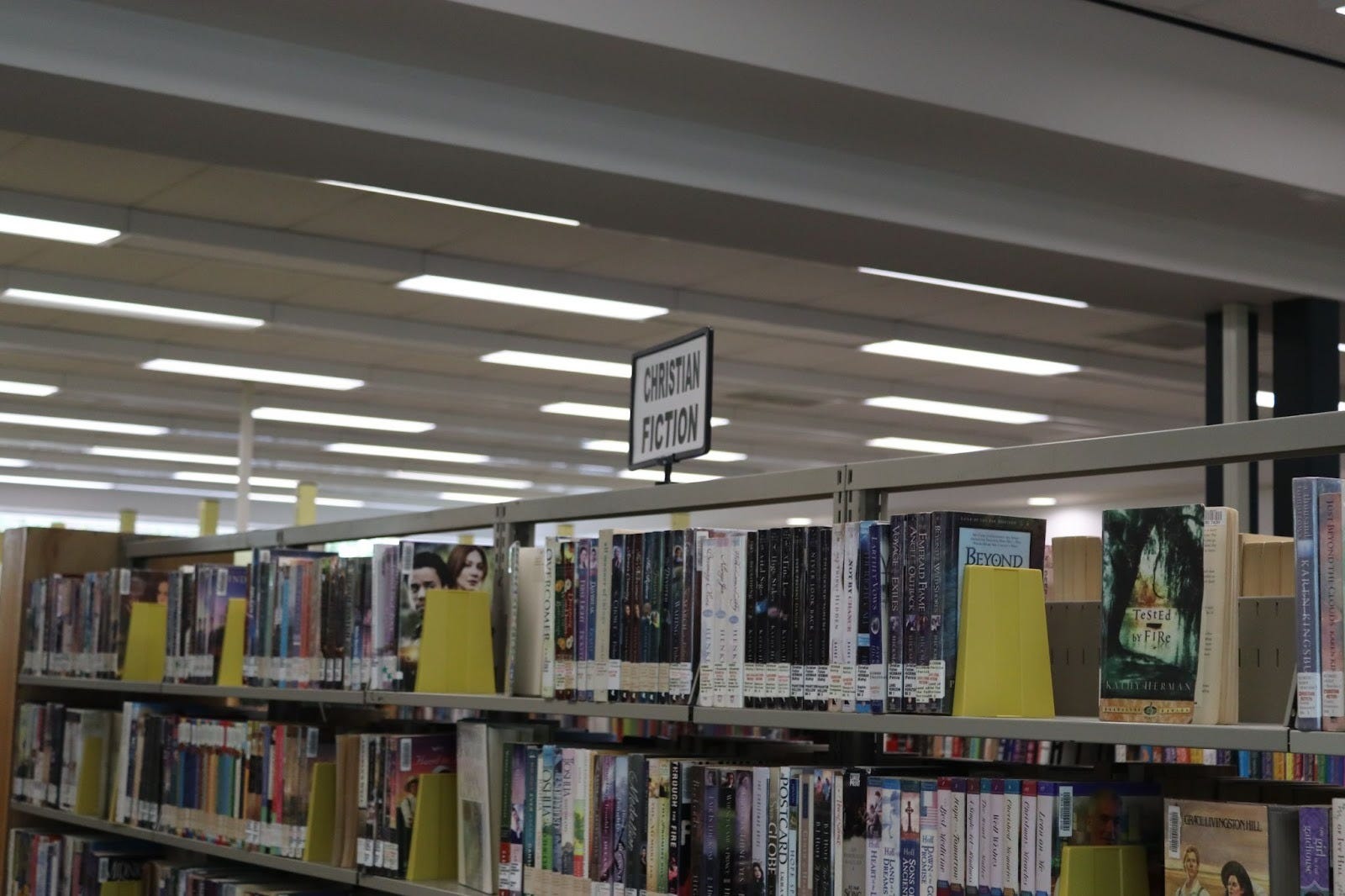
Perry’s pro-free-speech attitude sends ripples beyond Baker City, across Central and Eastern Oregon. Because Baker County Library is one of the larger libraries in Central and Eastern Oregon’s interlibrary loan consortium, they are often the only library that has enough space to hold more controversial books. This means that Baker County Library plays a key role in giving Oregonians access to left- and right-leaning children’s books. For example, Perry told us, Baker County Library is the only library in the consortium that houses Kirk Cameron’s BRAVE Books series, which promotes conservative Christian values. In nearby Idaho, threats of book challenges across an interlibrary loan consortium have caused the system to be completely dissolved, leaving many communities’ access to free books, controversial or not, severely limited.9 Idaho perhaps offers a warning for what can happen if book challenges aren’t met by strong opposition.
In Oregon, state-level politics are friendlier to Perry’s fight against censorship. Oregon’s governor, Tina Kotek, recently signed a bill into law that makes it illegal to ban books on the basis that they contain content related to a protected class like gender.10 As communities across the country confront challenges to the freedom to read, Baker County Library’s audacious attitude might show them what it takes to fight for the First Amendment.
Carmen Vintro
To read more stories from America’s public libraries, subscribe to our Substack below, visit our website and follow us on social media.
Julia Silverman, “Requests to remove books from public libraries are on the rise in Oregon. Here are the titles most in jeopardy", The Oregonian, <https://www.oregonlive.com/education/2024/09/requests-to-remove-books-from-public-libraries-are-on-the-rise-in-oregon-here-are-the-titles-most-in-jeopardy.html>.
“Endangered Books”, ACLU of Oregon, <https://www.aclu-or.org/endangered-books/>.
Marina Dunbar, “Multi-level barrage of US book bans is ‘unprecedented’, says PEN America”, The Guardian, <https://www.theguardian.com/us-news/2025/feb/07/book-bans-pen-america-censorship>.
“How Project 2025 tries to demonize LGBTQI+ People—and why it’ll fail”, National Woman’s Law Center, <https://nwlc.org/how-project-2025-tries-to-demonize-lgbtqi-people-and-why-itll-fail/>.
The other four principles are: (1) “Reading is a foundational skill, critical to future learning and to exercising our democratic freedoms”; (2) “Books are tools for understanding complex issues. Limiting young people’s access to books does not protect them from life’s complex and challenging issues”; (3) “Individuals should be trusted to make their own decisions about what to read”; (4) “Parents of one family should not be making decisions for other parents’ children”.
Katie Hawkinson, “New report shows it’s largely officials and organizations demanding books be banned - not parents”, The Independent, <https://www.independent.co.uk/news/world/americas/book-bans-parents-library-report-b2729102.html>; and “Extremists, Groups, & Ideologies”, Southern Poverty Law Center, <https://www.splcenter.org/resources/extremist-files/?meta_extremist_type=group&_s=moms+for+liberty>.
Eric Dolan, “Both sides favor censorship when children’s books conflict with their political beliefs”, PsyPost, <https://www.psypost.org/both-sides-favor-censorship-when-childrens-books-conflict-with-their-political-beliefs/>.
James Hanlon, “Regional library consortium members vote to dissolve Cooperative Information Network”, The Spokesman-Review, <https://www.spokesman.com/stories/2025/jul/14/regional-library-consortium-members-vote-to-dissol/>.
Amanda Waldroupe, “Bill prohibiting book bans in Oregon school libraries becomes law”, Oregon Artswatch, <https://www.orartswatch.org/bill-prohibiting-book-bans-in-oregon-school-libraries-becomes-law/>.
Incredible story! What these librarians are doing is so important - they’re on the front lines.