
“Tree huggers!” The words rang out across Eastern Oregon’s Olive Lake and reached us on the short pontoon where we were finishing a short workout. We looked back toward the campsite to find the source of the accusation: an older gentleman perched on a great throne-like camping chair in front of his large RV. Carmen and I erupted into defensive laughter – did we just get called tree huggers for exercising? We chalked it up to intergenerational and cultural misunderstanding. But I still felt a little stung and confused by the King of the Lake as we retreated to our tent.
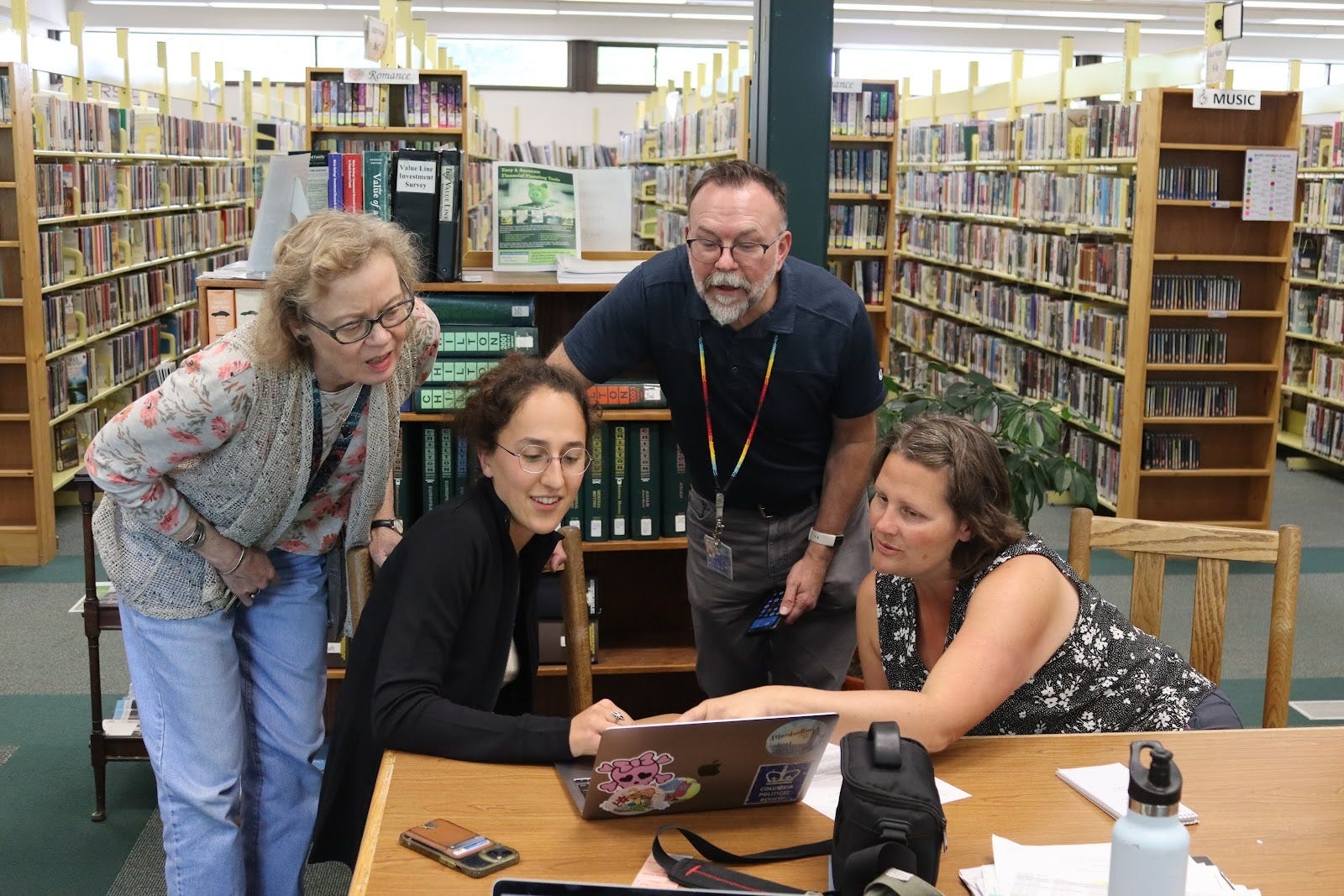
The next morning, we said goodbye to our beloved trees in the Umatilla National Forest and headed to the third library of the trip: the Baker County Public Library in Baker City, Oregon. Our first 300 miles on the road taught us that America’s libraries can be many different things: classrooms and playgrounds; refuges and safe spaces; community hubs and portals to the outside world. But it wasn’t until we met the volunteers of the Friends of the Baker County Library that we began to understand that a library’s meaning doesn’t only come from what it gives to its community, but what its community gives back to it.
Baker County Public Library is run by a small team of fantastic librarians under the leadership of Library Director Perry Stokes, whose strong and unorthodox approach to freedom of speech we discuss in this article. But the majority of the library’s staff are volunteers. Librarian Diana Pearson told us that 89 people volunteered their time last year, saving the County over $50,000 in labor costs in hours paid at minimum wage.
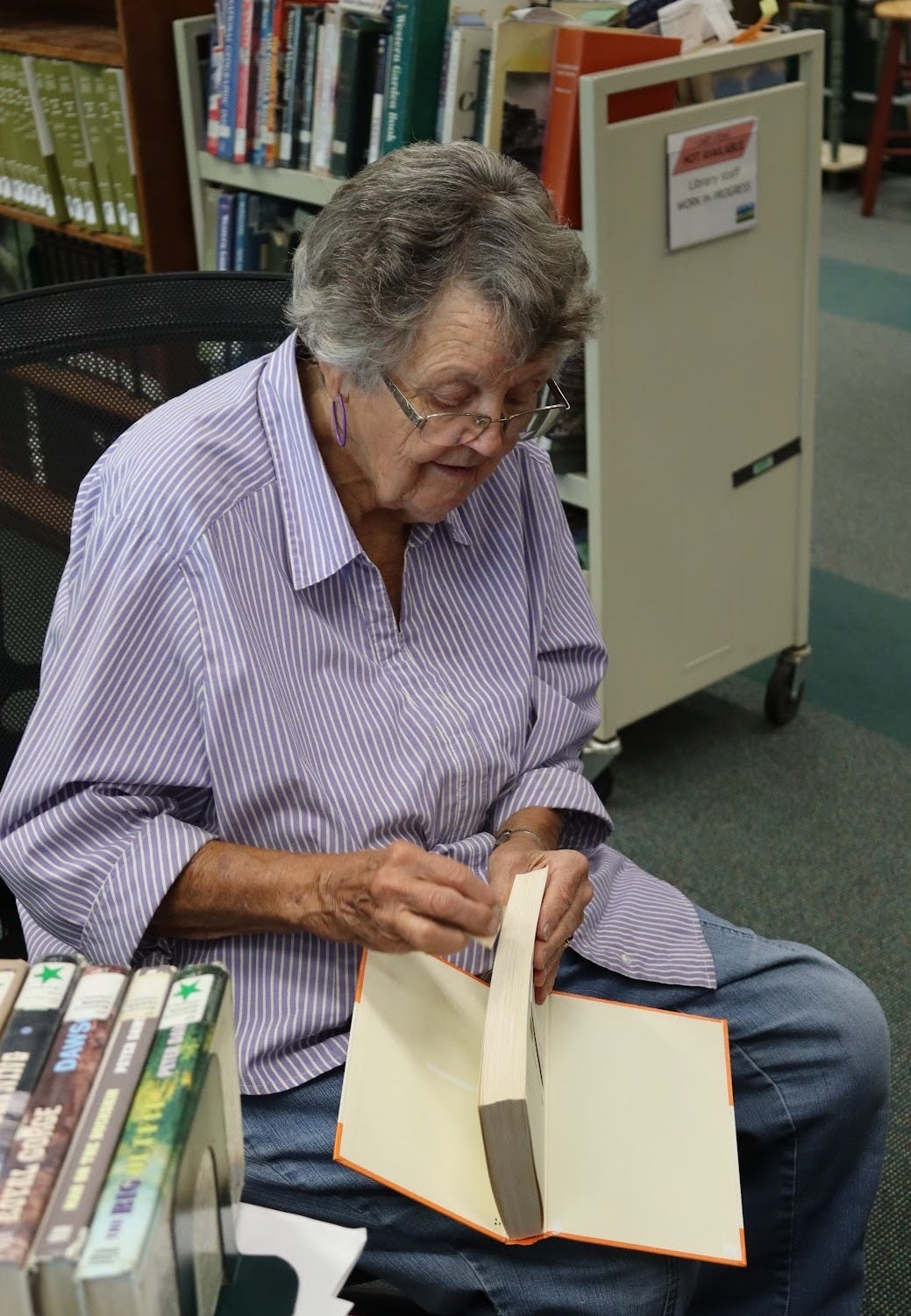
Diana introduced us to Wanda, a remarkable woman who has volunteered at the library for such a time that she couldn’t tell us when she started. “Wanda!” Diana called as we flagged her down awkwardly in the Christian Fiction section. Wanda stopped pushing the huge metal trolley in front of her and peered at us over round, silver glasses. Dressed in an oversized purple pinstripe shirt, matching purple hoop earrings and dark blue jeans, she looked devilishly stylish as she paused to consider the source of the interruption.
Wanda kindly took a break from her rigorous reshelving to speak to us at a nearby table. Determined not to fall behind on her to-do list, she brought a stack of books to clean with sandpaper while we spoke. As she scrubbed the pages of a bright orange hardback edition of Hard Summer, an ‘80s Western by Stephen Fugate, she told us that working in the library has given her retirement routine and purpose.
One day, Wanda had taken the bus into town expecting to work a shift, but when she arrived the doors were locked and the lights were off. Much to her dismay, the library was closed. Rather than feeling liberated by the lack of work, she said that it had totally disrupted her day, and she left feeling distressed.
The work gives Wanda’s day structure and meaning, and the people she has met give her community. “I really enjoy working here,” Wanda said. “I get to touch base with people. Diana is someone I work with, but really she’s a friend.” She smiled as she told us that Heather, a young staff member whom we had met at the help desk, had written her a letter addressed, “Dear grandmother of my heart.” She also told us that several library patrons have brought her yarn as a thank-you for her work, which she has been using to knit hats for the librarians. Unfortunately, since it was the height of summer, we weren’t able to see any of these hats – but judging from Wanda’s style, we both agree that it is safe to assume that the Baker County librarians are the most fashionable librarians in Oregon.
Carmen asked Wanda one of our final go-to questions: “What is your favorite memory in the library?” Wanda looked her dead in the eyes and paused. Shrugging, she declared, “I just work! The library just is. It’s here.” And with that, she rose to her feet, collected her freshly mended books, and strode back to Christian Fiction to crack on.
Our presence in the library caused a small stir, and soon we were speaking to the local press. Lisa Britton, a journalist for the Baker City Herald who grew up coming to this library, told us that she is more used to asking questions than answering them, but she was open to a trade: she would tell us more about what the library means to Baker City if we explained why on Earth two recent graduates from Portland and the U.K. were driving across America, library by library (an explanation that she later published in her article, “American Library Project Visits Baker City”).
Lisa told us that the library has always provided essential services to the Baker community, particularly during the COVID-19 pandemic. “The library wasn’t closed for long,” Lisa told us, “after a few weeks they opened a drive-through. That gave people something normal at a time when everybody was scared. It meant that we could still get our books for free when we needed them the most!”
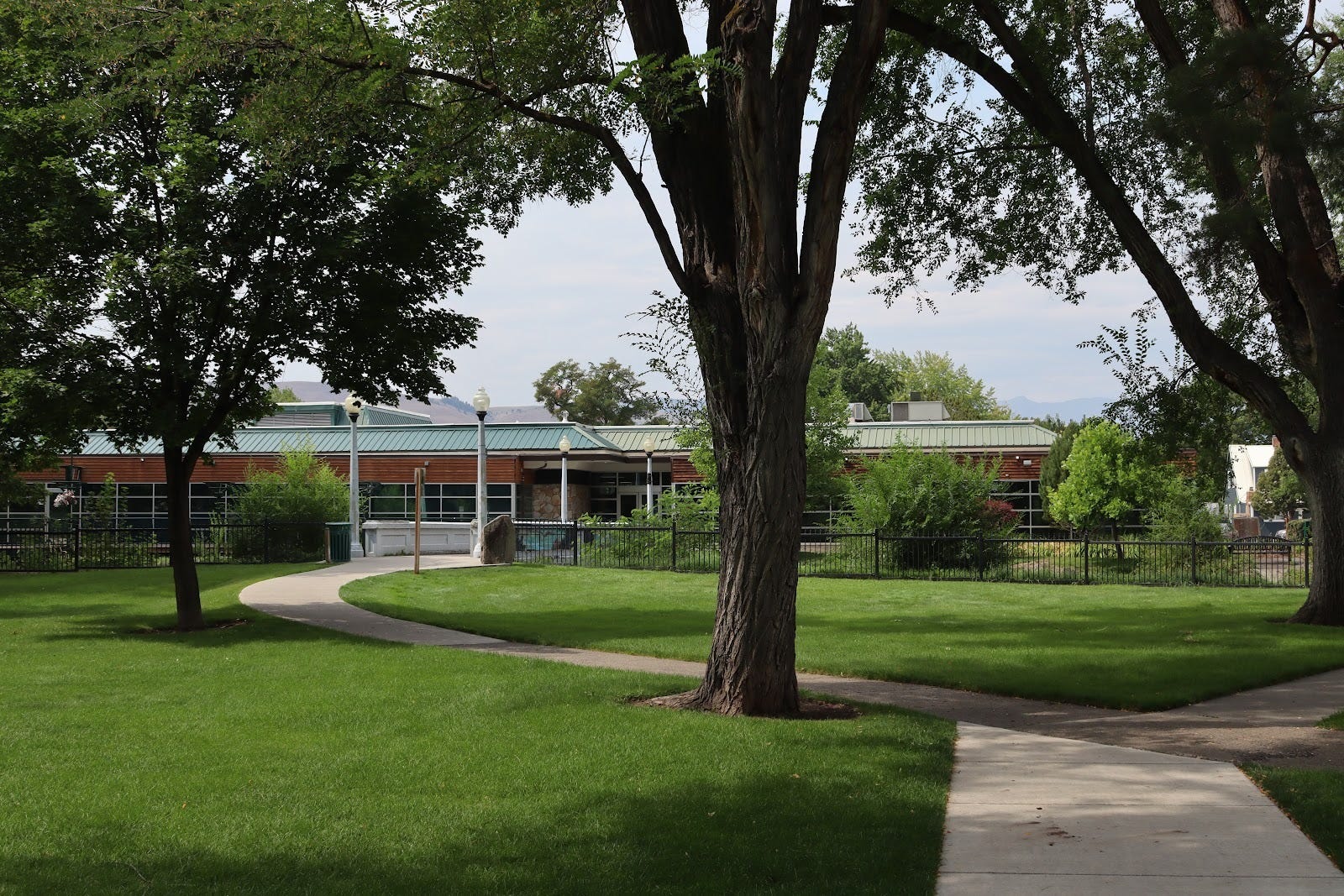
We spoke about how Lisa’s connection to the library changed when she became a mother. She told us that the children’s programming was essential for her family, particularly when her kids were very young. “Having Storytime here is special,” she explained. “The library is next to the park and the beautiful, rushing river, so kids get to learn, play and be outdoors all at once.” But the adult programming also gave her a space and community to explore her intellectual and creative interests outside of her role as a mom. For example, Lisa is an avid member of the Jane Austen book club, which meets once a month.
Though her kids are now a little too old for Storytime, Lisa’s son, Max, is back at the library as a volunteer. “Max wanted to gain some work experience, and the library said that they would help,” she told us. “He isn’t set on becoming a librarian, but volunteering here has already helped him to learn so much about having a job.”
Working in the library has helped Max to develop his professional skill set. He has to manage his own time and to-do lists, communicate with patrons from a range of different backgrounds, and understand and work within the library’s various systems of information management. Max is also one of the youngest members in an intergenerational team of volunteers, which has given him the opportunity to learn from people who have been at the library for longer than he has been alive.
This includes one very special relationship. Lisa told us that her father also volunteers at the library: “It means so much to him to be able to work alongside his grandson,” she said. “Their shared shifts give them time to be together and to strengthen their relationship, as well as to give back to a place and community that has been in both of their lives for a long time.”
Nurturing relationships between the older and younger generations of Baker County is embedded in the library’s resources and programming. This year, the library ran a “Human Library” program. In each session, six people with diverse experiences and perspectives (“human books”) are asked to share their stories with the community. Speakers have ranged from a recovering addict who described the realities of addiction to a member of Baker City’s Hispanic community who spoke about life as an ethnic minority in rural America. The librarians told us that the program is a powerful platform for different voices from Baker City to be heard and for neighbors to try to understand each other at a time when they often feel divided along political lines.
Patrons can also check out Tales Life Story Interview Kits from the library for guidance on having conversations with older people about their life stories. The kit includes 150 cards, each with a different oral history question aimed at capturing stories from different stages in a person’s life: “What is the bravest thing you have ever done?”, “When did you feel most alive?” and “What was your dating life like in your twenties?”
Tree-hugger man flashed into my mind as we left the library. I felt like his comment came from a place of alienation – to him, the sight of two young people doing push-ups signaled a whole liberal ideology that he opposes and defines himself against. It was a small example of societal polarization across generational, economic and political lines that the library works to bridge.
Then, I thought back to Wanda’s shrug: “The library just is.” So says the library’s book-restoring, trolley-pushing, grandmother of the heart. Baker County Public Library is built every day by the hard work of its staff and volunteers. It empowers people to share their stories through reading, mentoring and programming. In doing so, it creates a community of listeners and a culture of compassion. Without it, perhaps we would all be more inclined to yell at one another from afar.
Oliver Jakes
To read more stories from America’s public libraries, subscribe to our Substack below, visit our website and follow us on social media.
Such wonderful insight into the community-building potential of libraries – so many things I didn’t realize.