
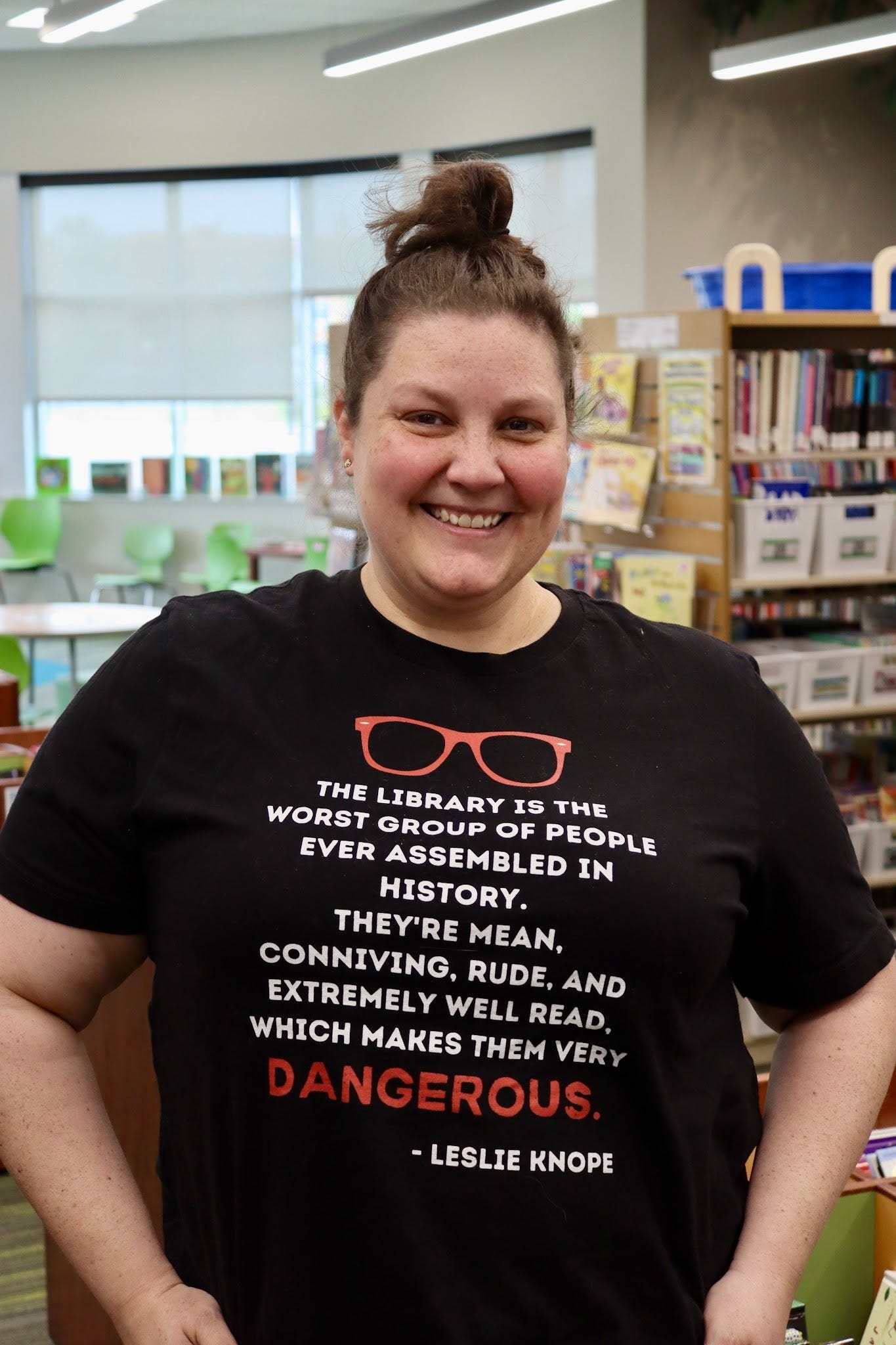
Children’s librarian Jessica proudly wears a t-shirt that reads, “The library is the worst group of people ever assembled in history. They’re mean, conniving, rude, and extremely well read, which makes them very dangerous.” – Leslie Knope.
Affectionately named “Old Betsy,” a large, early nineteenth-century cannon guards the front steps of Birchard Public Library in Fremont, Ohio. The library itself is a red-brick building perched on a hill once occupied by Fort Stephenson, where in 1813 a small group of American soldiers fought off a much larger British force during the War of 1812. During the battle, Betsy was the only cannon Major George Croghan and his soldiers had behind the fort walls. But by constantly wheeling her around the battlements, the Americans tricked the British into believing that their arsenal was much larger. The ruse worked, and the British abandoned the siege after only two days.
Birchard Public Library was established on this historic site in 1874 through a trust left by Sardis Birchard, the uncle of U.S. President Rutherford B. Hayes. After his presidency, Hayes helped to oversee the creation of the library “for the free use and benefit to the people of Sandusky County,” and served as Chairman of its Board of Trustees until his death in 1893. Today, more than 150 years later, Birchard is still a popular library, a symbol of peace and independence, and a memorial to the people that died in service of the “Great American experiment.”
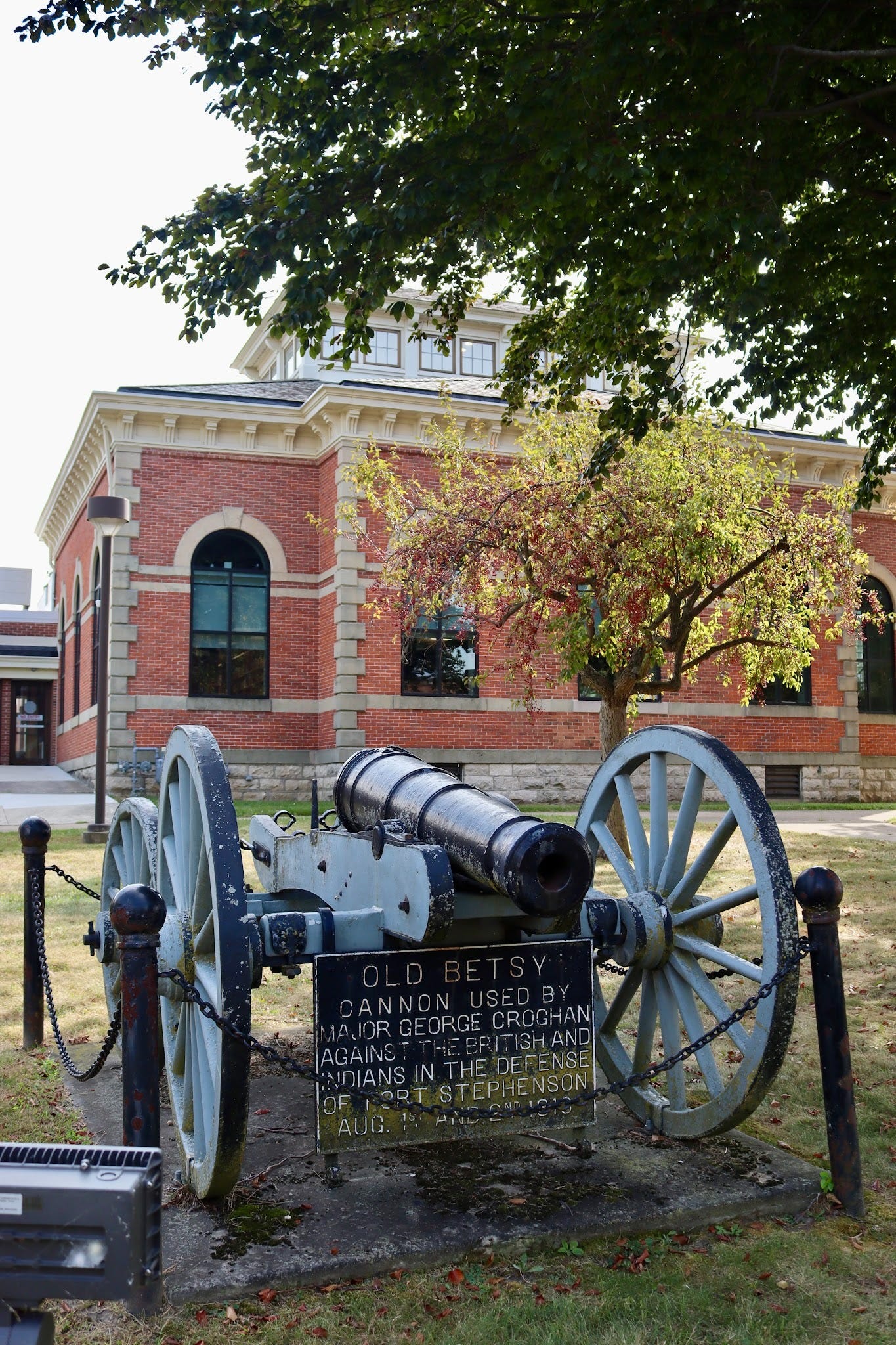
A cannon nicknamed “Old Betsy” stands watch outside of Birchard Public Library.
But it has become increasingly difficult for the library to remain a place of peace, and neutrality. The influence of pro-censorship movements across Ohio can already be felt in its libraries. “We are worried about the removal of DEI in local government and universities,” a group of patrons told us. “We’re all preparing for the inevitable.” The group were particularly concerned about their local state representative’s affiliation with “Protect The Children,” a state-wide organization that seeks to challenge the “indoctrination” of schoolchildren, particularly “harmful curriculum” associated with sex education and DEI.1 Though this campaign is primarily focused on schools, public libraries across America are increasingly being drawn into similar political battles, as we found when we got kicked out of a library in Idaho.
Like at Birchard, the librarians and patrons we spoke with across the country shared an existential fear that politicians, activists, campaign groups, and commentators are increasingly seeking to politicize library spaces through widespread book banning campaigns. According to the American Library Association, 2025 saw 129 book challenges in Ohioan public libraries, up from 26 in 2024. Two of the most targeted books were Young Adult novels by Rick Riordan, The Sword of Summer and The Hammer of Thor, which feature Muslim and gender fluid characters.2 This reflects the broader theme of censorship in today’s libraries, where books that depict LGBTQIA+ themes, non-white characters, and sexual education are deemed to be “harmful for minors,” which has forced some libraries to close their doors to children entirely.
For Joan, an adult reference librarian at Birchard, any group that sees a library as a battleground, where ideologies can be asserted and contested, fundamentally misunderstands the reality of their day-to-day existence. “We pay attention to history and politics,” Joan said, “but honestly the biggest part of this job is customer service.” Most of her time is spent helping patrons find information, answering questions, selecting books, and managing the countless small interactions that make a public library function.
“It is one of the more important issues for us not to censor,” Joan said. “We need a variety of books for a variety of people. We have had complaints about LGBTQIA+ books, but we haven’t taken them off the shelves. We care about diversity.”
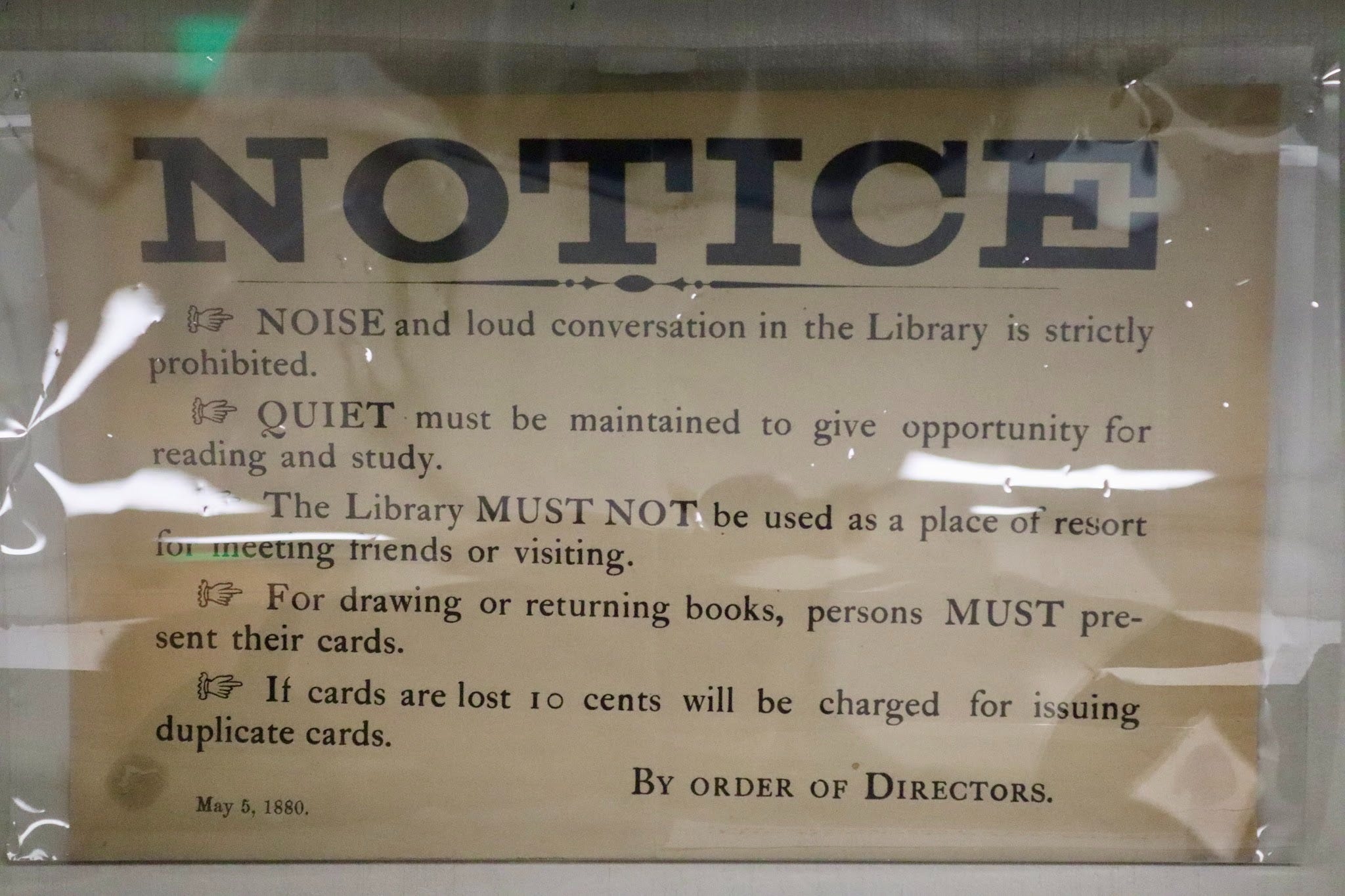
A Directors’ Notice from Birchard Public Library dated, May 5, 1880. It is stored in a display case on the ground floor, showing visitors that its strict rules no longer apply.
The library is already making it clear that they will fight against censorship if they need to. They frequently show support for groups that are most affected, for example by creating a “Love Is Love” display to point people towards resources on LGBTQIA+ issues and representation in fiction. Birchard’s staff repeatedly affirm the library’s neutrality, maintaining Hayes’ original vision for it. “This place is for all the people of Sandusky County,” Joan said, “and that is why it is so important.”
The children’s department is always under pressure to provide the library’s youngest patrons with age-appropriate material and activities. Jessica, a children’s librarian, has worked at Birchard for more than a decade. Long before that, she was one of the children attending programs there. The department recently underwent a major expansion, creating more room for activities, play, and family events. The redesign reflects how modern libraries increasingly function as community spaces rather than simply repositories for books.
“We are not shushers,” Jessica laughed, “those days of librarianship are gone. We are here to make a supportive environment for creativity and fun, and sometimes that gets a little loud.”
The librarians of Birchard Public Library are committed to keeping the library as a productive, safe, and politically neutral community space. Despite Old Betsy’s continued presence, Birchard manages to avoid becoming a battleground by focusing on serving every patron equally, preserving its 150-year old mission and celebrating the diversity of its community.
~
Oliver Jakes
To read more stories from America’s public libraries, subscribe to our Substack below, visit our website, and follow us on social media.
‘Homepage’, Protect the Children, <https://protectohiochildren.net/> [accessed June 11 2026]
‘Book Ban Data’, American Library Association, <https://www.ala.org/bbooks/book-ban-data> [accessed June 11 2026]