
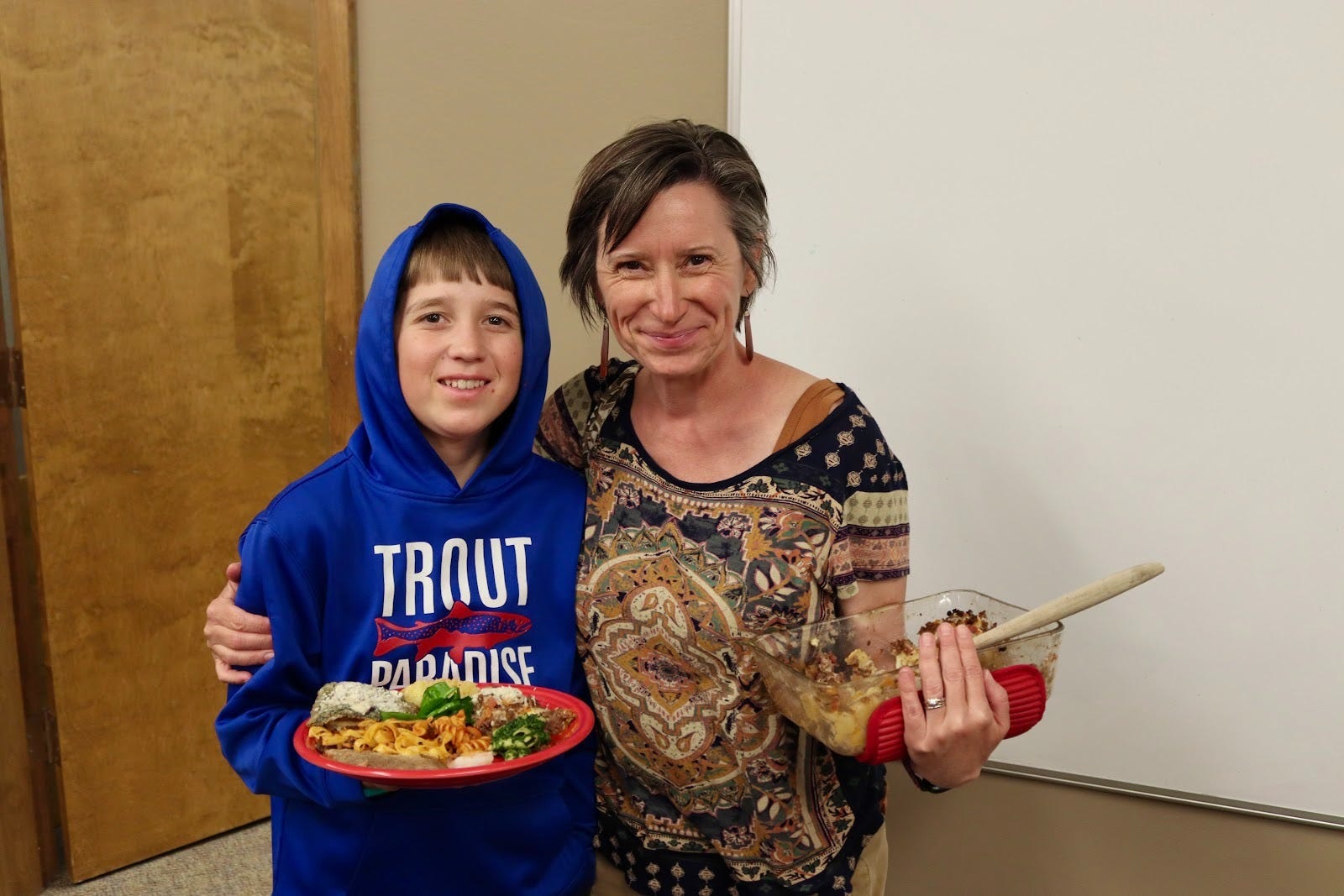
When we first emailed the West Yellowstone Public Library to ask if we could attend any of their events, we received a cryptic reply. One of the librarians, Samantha, responded that the library would not take part in the American Library Project in any official capacity. But, she said, she would be happy to speak with us on her own time, and we could attend some of the library events, but the extent to which we could report on them would be up to her Director.
After being kicked out of the Idaho Falls Public Library the day before, grouped in with political and religious agitators who had repeatedly tried to campaign in the library, and visiting another Idaho library that was forced to become adult-only after facing sustained attacks over children’s access to books, we understood why West Yellowstone might feel that they needed to protect themselves and avoid drawing attention.
As we drove by the dense banks of lodgepole pines and repeated “Be Bear Aware” signs that frame the road into West Yellowstone, we tried to learn from our mistakes in Idaho Falls and come up with a plan for how to make the librarians feel at ease with our presence.
We parked on the street outside of the library. It was a wooden building with forest green paneling and tall windows. Inside we were greeted by the librarian at the reception desk: “How can I help?” she asked with a warm smile.
Carmen introduced us and asked if we could join Cookin’ the Books – a community potluck dinner that the library was hosting that evening.
The librarian’s smile collapsed into a grimace. She replied awkwardly, “I think, you know, I think, maybe, you might not be able to do that.”
“I see,” Carmen replied, expressing little of the sinking feeling I knew we were both experiencing. “Do you think it would be possible to speak to the Library Director? We really want to write about why people love this library, because we know how crucial public libraries are and what a difficult time it is at the moment.”
Soon we were giving the same explanation to Library Director Michele DesRochers. She was careful to ensure that the event—which the community looked forward to each month—would not be disrupted by outsiders. She told us that as long as we didn’t make it about ourselves, we were welcome to participate.
“Everybody signs up to make a recipe from the same cookbook in the library’s collection,” Michele explained. “Tonight it’s this one,” she said, gesturing to a large, red hardback on the table in front of us. “You don’t need to bring anything though.”
We protested. Of course we would bring something! But as we flicked through The Silver Spoon by Phaidon, hailed as the “one-volume encyclopedia of Italian home cookery,” it became increasingly clear that only a handful of the recipes could be assembled in the trunk of a car. We settled on fagottini di mortadella—a ricotta, pepper, and walnut whip folded into mortadella twirls—pencilled it into the sign-up sheet, and walked into town to find the local grocery store.
After failing to find mortadella (and revealing our city-slicker naïveté to the grocery store staff who laughed when we inquired about the item’s whereabouts), we resorted to salami, and returned to the library parking lot to assemble our potluck dish. More cars pulled in as we fumbled around with our ingredients, and several people walked by us carrying deep dishes, serving plates, and crockery.
Armed with our fagottini di whatever-we-could-find, we returned to the library and walked over to a large conference room. Around fifteen people had already arrived, and an additional ten or so filtered in after us, each depositing a dish on either the “mains” or “desserts” table.
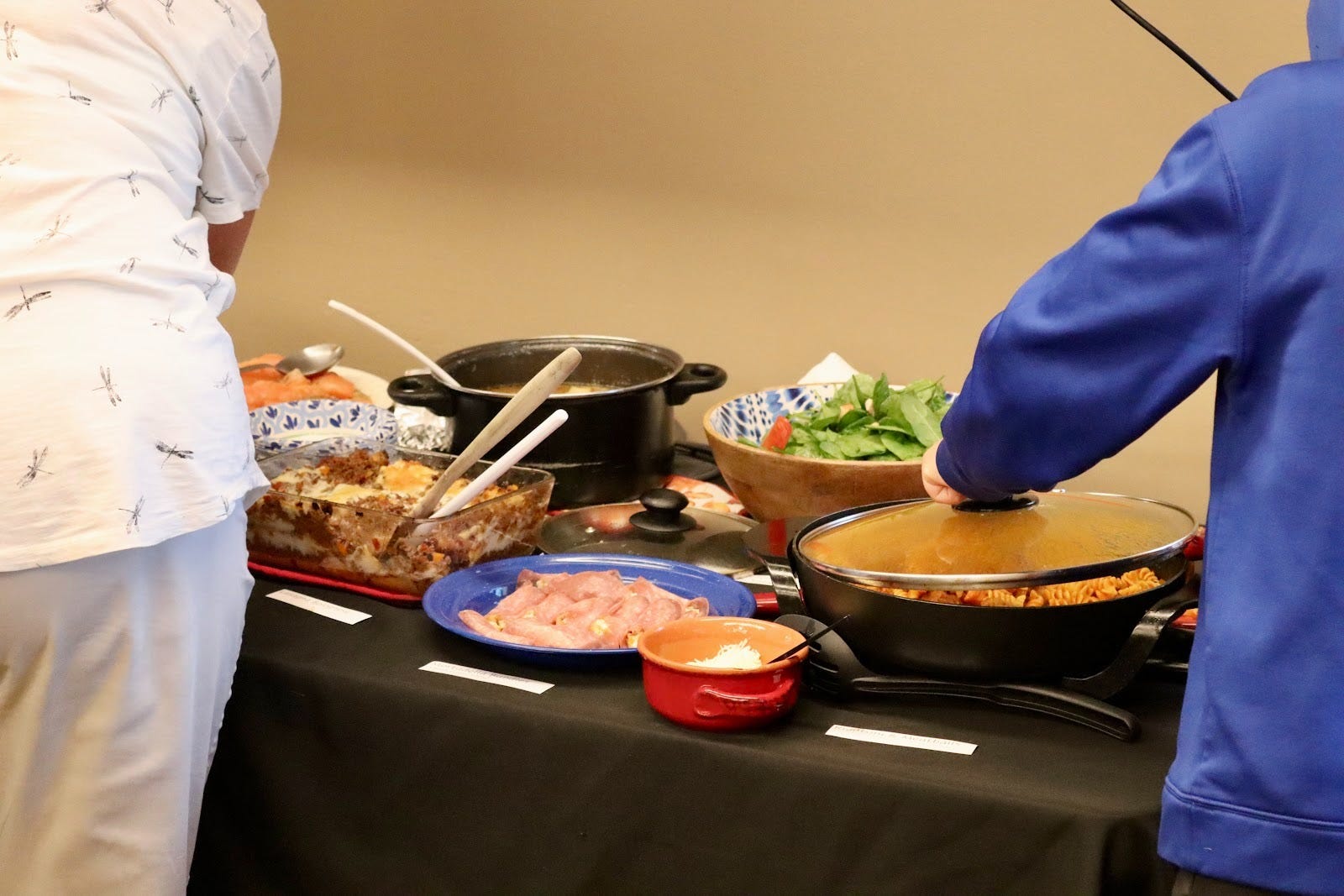
Carmen and I set our sloppy salami rolls down next to a beautiful lasagna still bubbling from the oven, took our seats at the table, and turned to our neighbours. First we met Jane, a twenty-two-year-old agriculture teacher and track coach at the local school, who had moved to West Yellowstone just a few weeks earlier. Jane signed up for Cookin’ the Books after she had come by the library to use the Wi-Fi. She brought a potato soup which later became a roaring success, and told us she was grateful to have been pushed out of her comfort zone. “It makes a nice change from tacos,” she laughed.
Carmen got chatting to Elsa – a voracious reader who had baked a berry cobbler. Within minutes, Elsa had recommended a book based on Carmen’s interest in environmental literature. I met Joseph, who had grown up in West Yellowstone, but was attending the event for the first time. “They wanted me to come after I brought snacks to game night,” he joked.
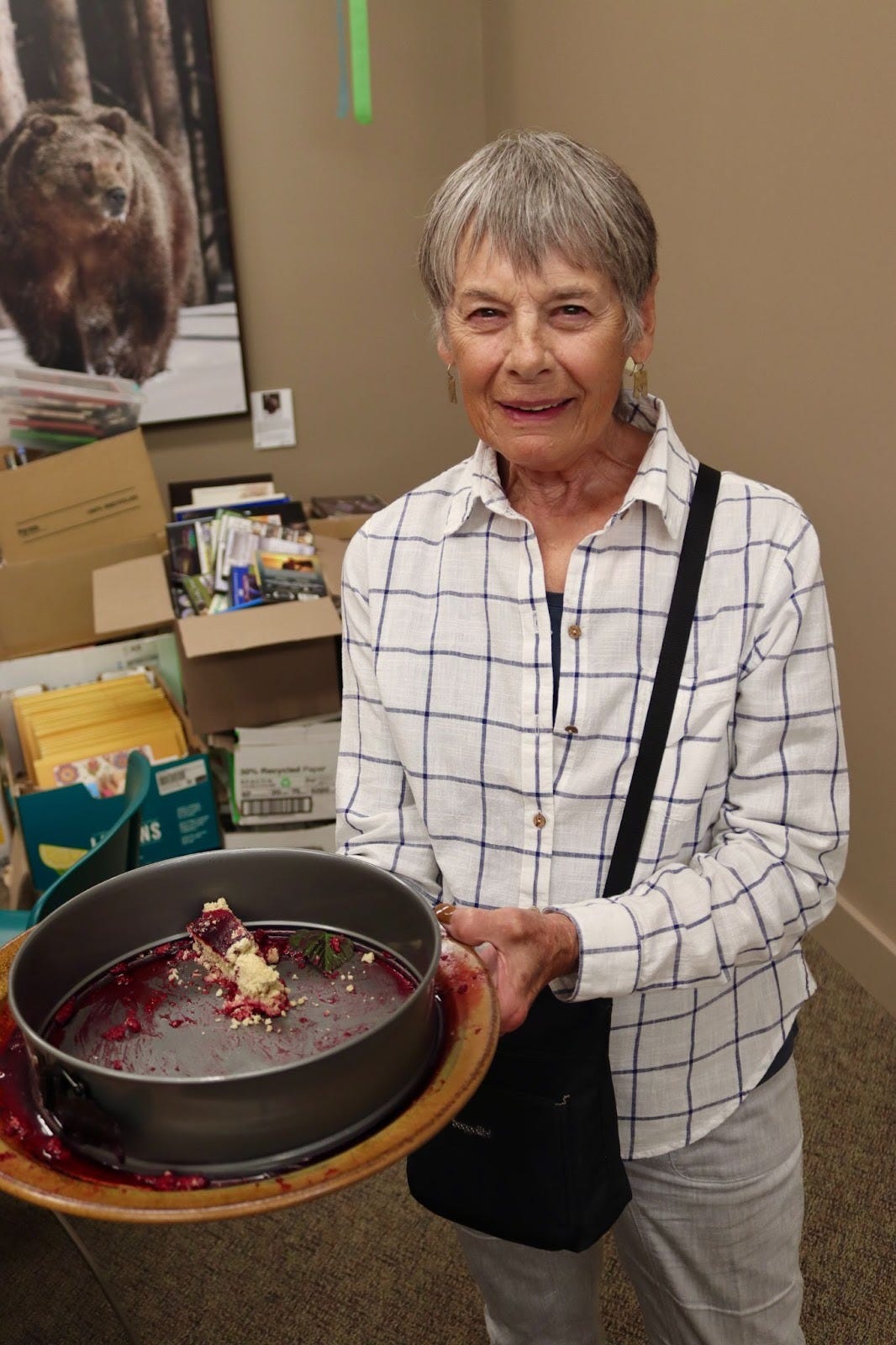
I introduced myself to a young woman sitting across from us.
“Oh, hey!” she exclaimed, “I’m Sam – I emailed you.”
Relieved to hear that Michele had given us the green light to be there, Samantha explained that Montana’s librarians are scared of experiencing similar kinds of issues faced by their colleagues in Idaho. “Librarians are stewards of information without judgment,” she said. “We don’t take a political position, and we try to give reliable information to anybody that asks for it. But there have already been murmurs about anti-library hate here. There was an anonymous post on the town Facebook page that alleged the library was doing all sorts of bad things.”
Sam added that the library is used by a lot of tourists, from a teacher at the New York Philharmonic who conducted an orchestra via Zoom to a man who came to watch a live stream of his granddaughter’s graduation. But the town’s focus on tourism can make it difficult for the residents to develop a community that feels really permanent.1
“Cookin’ the Books is a great way for local people to get together. It connects people who have lived here forever with people who have just moved, and bridges gaps across generations,” she explained.
The popular potluck is also helping Sam to recruit interviewees for the library’s oral history project, Voices of West Yellowstone, which aims to preserve the stories and memories of members of the West Yellowstone community. She explained that events like Cookin’ the Books get people to engage with the library in new and fun ways, which is often the first step towards agreeing to an interview. Those interviews have already revealed so much about the town’s history, covering everything from untold local heroics during the 1988 Yellowstone fires to changes in the local forest.
Soon each person took turns sharing their name, what they had made, whether they would make it again, whether they made changes to the recipe, if they had learned anything, and why they chose the dish.
Much of the decision-making was guided by the availability of ingredients in town. One man, Bill, brought huckleberry pancakes with homemade syrup and huckleberry cookies, all made from berries he’d foraged nearby. As he finished introducing his dish, a tentative voice asked, “Where did you find the huckleberries?”
Bill smirked, unwilling to reveal his secret spot. “You can’t get there from here!” he chuckled. Later, he told us that when you find a huckleberry patch, you have to guard it with your life.
Melissa—the mind behind the stunning lasagna that was casting a long shadow over our ricotta rolls—shared that the deliciously juicy meat in her lasagna was venison that her husband had hunted rather than beef. His job as a park ranger tends to keep their freezer stocked for months, she added.
After the introductions, we piled our plates with the green salads and saucy pastas of the encyclopedia of Italian home cookery. Somehow, the blue enamel camping plate we had served our dish on was picked clean, save for a few sweaty marks where the salami had been.
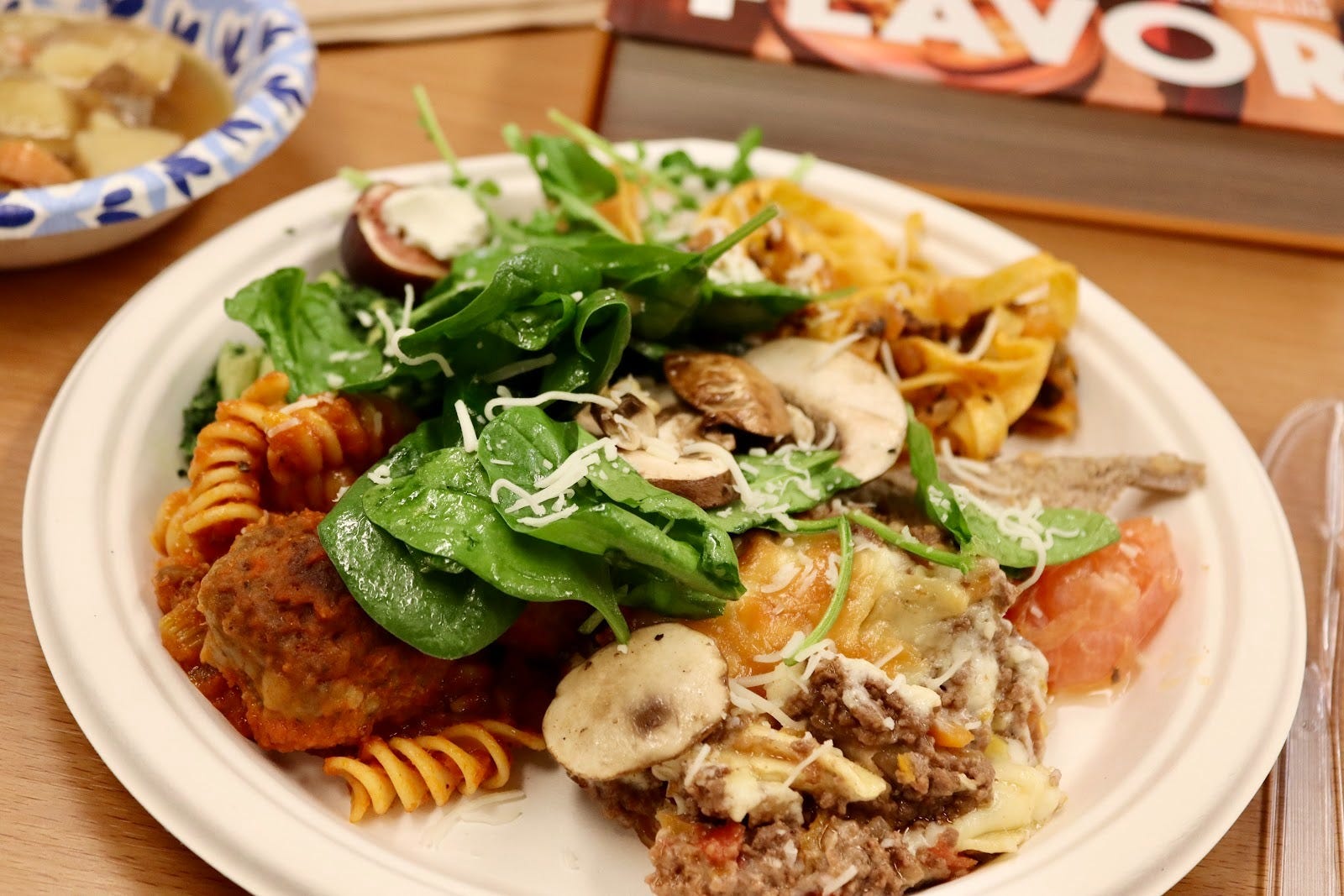
The food was tremendous; I was a particular fan of the fig, honey, and goat’s cheese dish that Michele had prepared. We later learned that she had moved to West Yellowstone 25 years ago to take a job as a professional chef, and that Cookin’ the Books was inspired by a series of potlucks Michele had attended with cooks from local restaurants.
“Everyone wanted me to teach a cooking class,” she shared with us the following day, “but I wanted to do something that would inspire people to cook new recipes for themselves.”
After dessert, Melissa stood up. She thanked Michele for giving the town a safe community space that it didn’t use to have. “Advocating for libraries publicly is so important,” she said, “because they are facing real threats. We need to fight for this place! All of us have to speak to our local representatives, talk about the library on social media, make sure people know how valuable it truly is.”
Rising from her chair, Michele told the room that when she took over as Director, she felt the town needed a community space. She said that since the city council is mostly geared toward tourism, the library had to become a place where the community could gather year-round, especially in those dark winter months when snow piles high and the roads freeze over.
“Libraries are changing,” she told us later. “This is more than a quiet place to get books and to read. Cookin’ the Books is just one of the ways that the library can bring people together and help them be creative. This is why we have to protect it.”
~
Oliver Jakes
To read more stories from America’s public libraries, subscribe to our Substack below, visit our website, and follow us on social media.
Over half of the town’s industry is based on seasonal tourism; a 2024 census suggests that, of the 855 homes in West Yellowstone, approximately 362 (42%) are vacant or used as second homes, and many more are rental units used by tourists and seasonal workers. See https://datausa.io/profile/geo/west-yellowstone-mt#economy and https://data.census.gov/table/ACSDT5Y2024.B25002?g=160XX00US3079525.
Such an inspiring community bonding activity! I’m imagining a Cookin’ the Books event in all neighborhoods can save the world.