
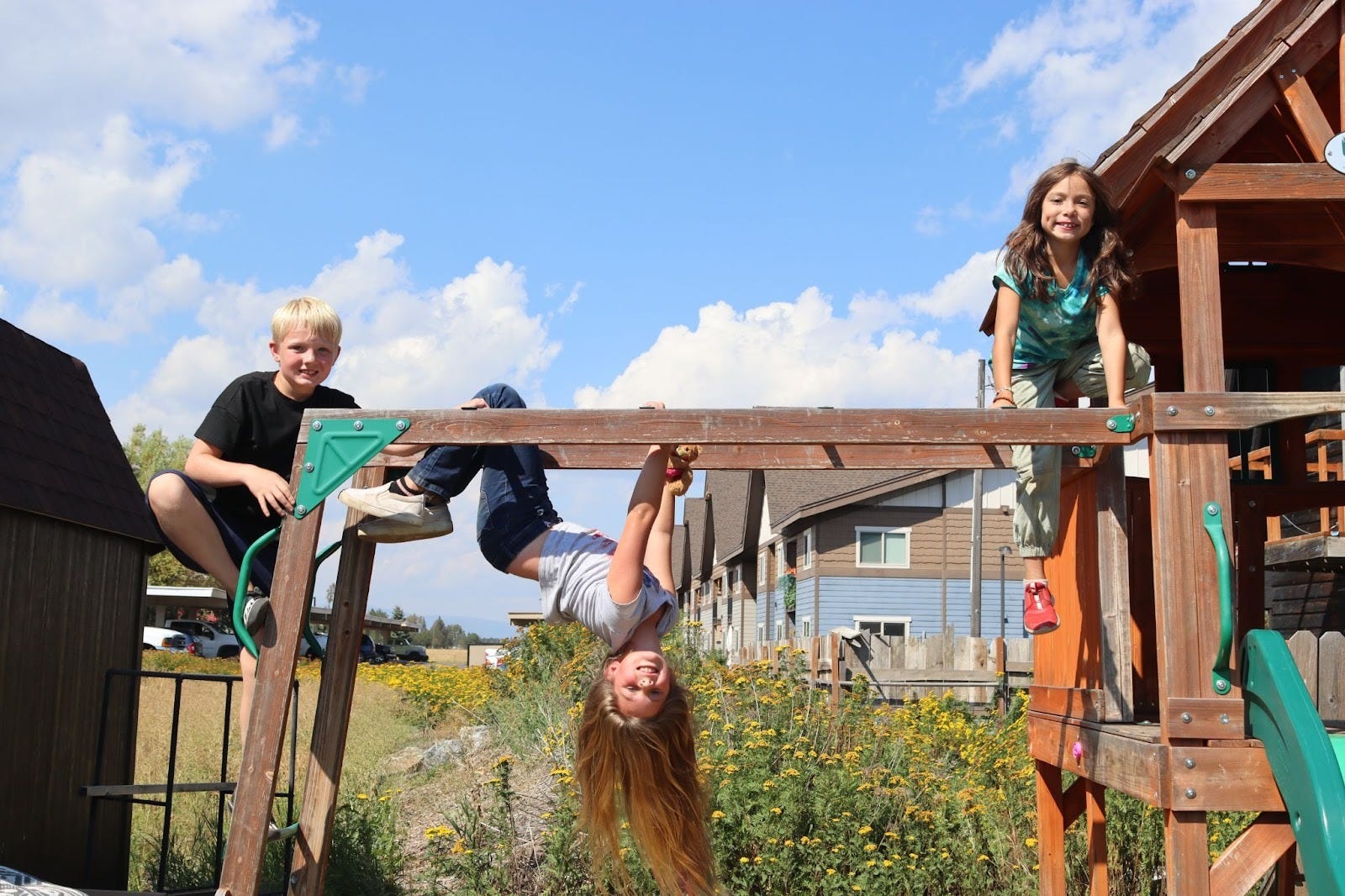
“They’re baby garter snakes!” Jasmine declared with a grin as she showed us the wriggling reptiles in her fists. The eight-year-old brought one hand up near her eye, studying the snake trapped inside. Aiyanna, Jasmine’s older sister, stood at a cautious distance, watching the snakes squirm and flick their tongues with a mixture of excitement and disgust.
“You put those down young lady!” their grandfather, Clifford, commanded with the authority of a voice shaped by years as a Reverend. The girls ran back across the ranch to return their captives to the small patch of weeds below the solitary farmhouse. Their mother, Sherry, called after them: “Girls, go and put your swimsuits on please! We need to hurry up if we want to get to Smiley before sunset.”
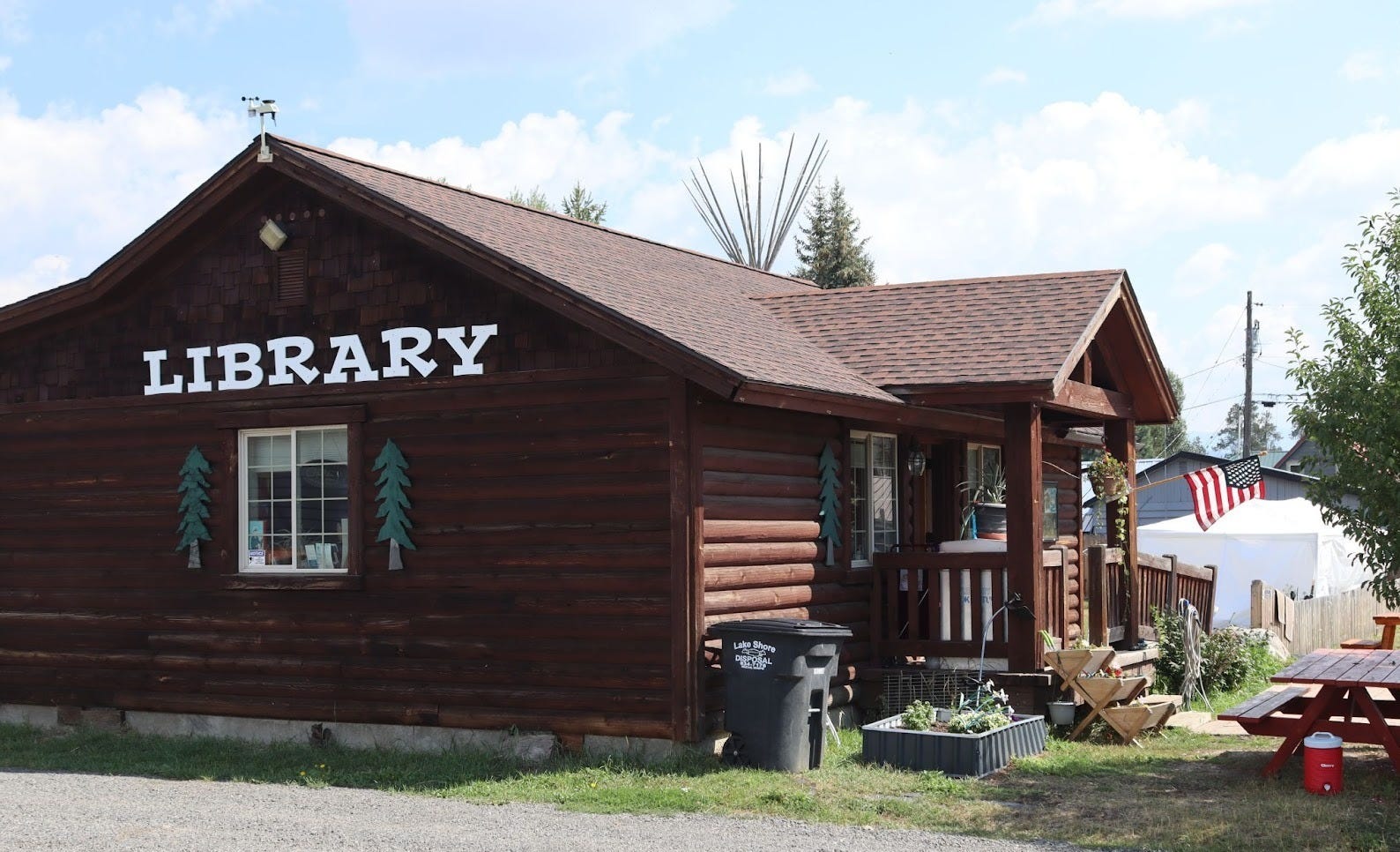
Seven hours earlier, Carmen and I arrived in Donnelly, a small town in rural Valley County, Idaho. We parked outside of a wooden building with one word on the side in large white letters: “LIBRARY”.
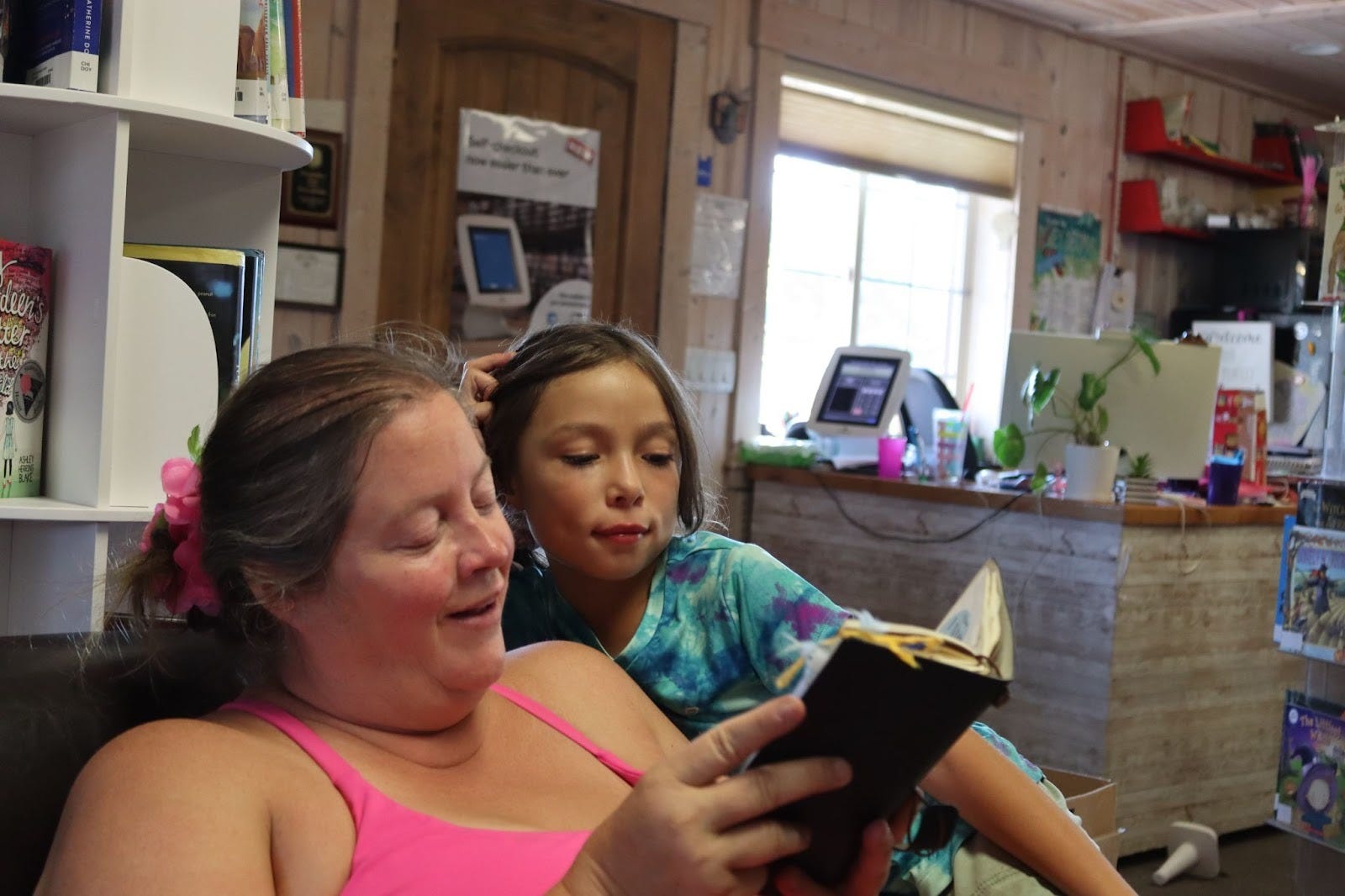
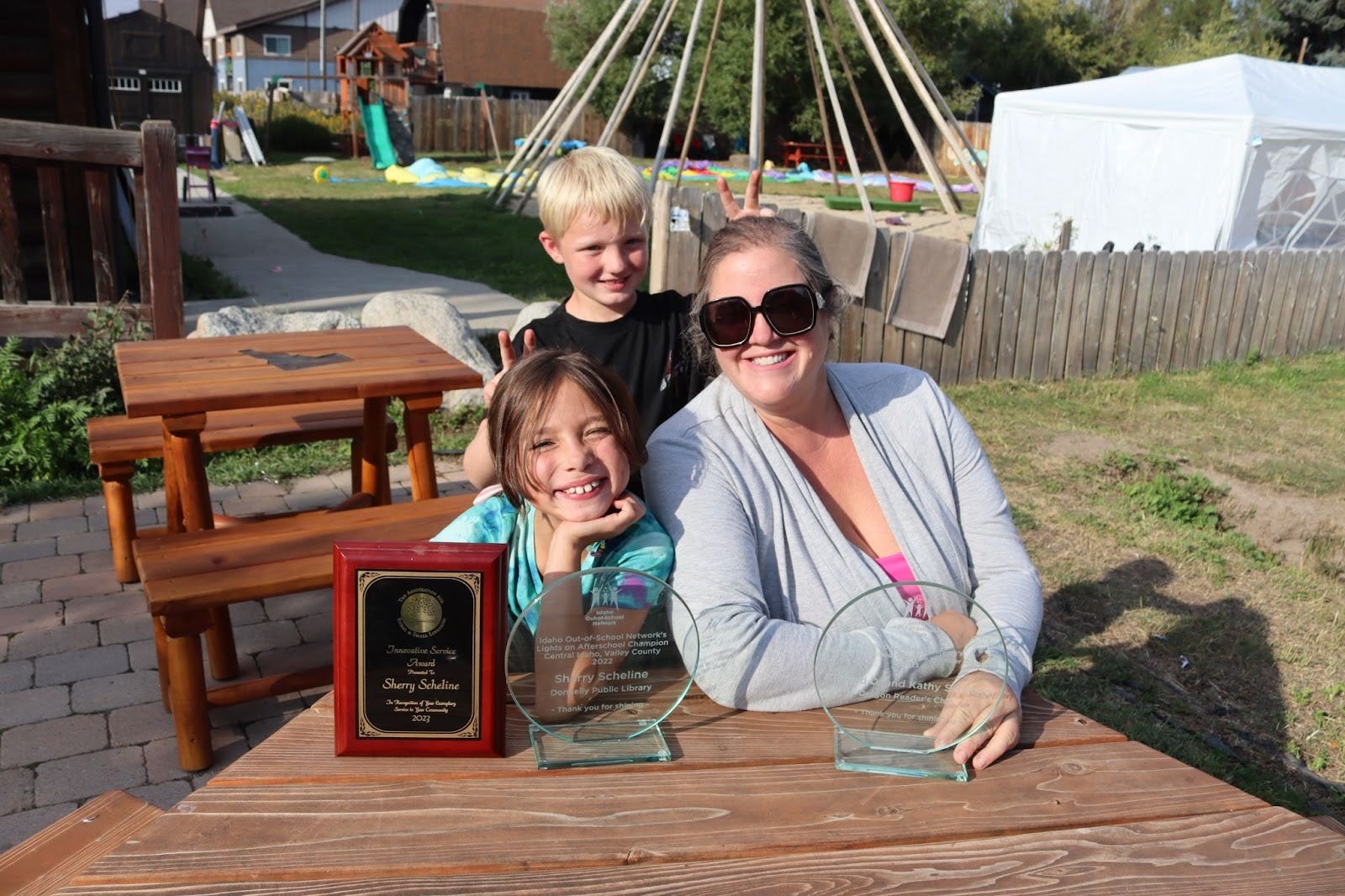
Inside the single-room building, we met Library Director Sherry Scheline, who welcomed us to Donnelly with open arms, offering us her ranch as our campsite for the evening within minutes. We sat together for several hours, talking about how Donnelly Public Library came to be and the ongoing attacks on children’s freedom to read in Idaho.
Whether it’s organizing “Single Dads’ Night” – an annual event where the library takes Donnelly’s single dads out for dinner and drinks – or loaning out a bouncy house for birthday parties, Sherry approaches small-town librarianship by noticing what people need and making room for it. Nowhere is this more apparent than in her relationship with her daughters.
Jasmine and Aiyanna used to live down the road from the library with their birth mother. They went to the library every day, whether to read, hang out, or attend one of Sherry’s programs – Storytime, LEGO club, crafts night, etc. The ‘library kids’, as Sherry called them, loved spending time with her parents, affectionately known by all the children in Donnelly as ‘Grandma and Grandpa Library’. One day Jasmine and Aiyanna didn’t show up, and Sherry knew something was wrong. A second day went by, and a third. At that point, Sherry called the police and asked for a welfare check on the girls’ house.
The children were taken into foster care. When the sheriff asked them if they had any family in town, they said yes – two grandparents. “The sheriff couldn’t believe it,” Sherry told us, “how had nobody realized that their grandparents were around? He asked for their names, and Aiyanna replied: ‘Grandma and Grandpa Library!’”
Everyone in Donnelly knows Grandma and Grandpa Library, and the sheriff was no exception. He contacted Clifford and asked if he could take care of Jasmine and Aiyanna for a few days while his office found them a suitable home. Clifford, Kathy, and Sherry welcomed the girls to their beautiful ranch, which has been their family home since they moved west with the help of the Homestead Act in the late 1800s. A few days became a few weeks, and before long Sherry decided to adopt them.
“You would be surprised how many librarians adopt kids from the library,” Sherry said. “It’s really common. I go to national conferences every year and meet librarians from all over the United States. So many of them have similar stories to mine. It’s what we do: we care for our communities in any way we can.”
Sherry checked the time – already close to 3 p.m. “We run our after school program five days a week,” she said. “It’s the only after school childcare available in Donnelly. We always walk to the school to pick the kids up. Do you want to join us?” We nodded and followed her ten minutes down the road to the elementary school, where we met Sherry’s youngest daughter, Jasmine, and two of the other ‘library kids’.
At the back of the library garden, a willow leans over an old tire slung from one of its branches. As one of the children, Rylan, talked me through the difference between real monsters and imagined ones, Jasmine folded herself into the tire while her friends spun her like a coin set loose on a table, swinging close enough to the trunk to make me wince. “We are the wild girls!” she called out as she spun in the shade of the willow.
Sherry uses the after school program to focus on building friendships between the library kids and helping to broaden their education, always following the same routine: play, lesson, snacks, reading. Once we had finished step one, we moved onto step two.
The library is stocked with a host of pre-made after-school lesson packs, each of which contains some information and exercises to engage kids. This semester, the kids are focusing on STEM. Today’s lesson: aerodynamics. This would be the first lesson taught by the library’s most recent hire, Jacqueline.
The children gathered around their new instructor. As she introduced the kids to lift, weight, thrust, and drag, Jacqueline decorated her reading with little jokes and asides to make sure the kids were engaged and on board. Once a round of questions had established that we all more-or-less understood, we moved into a challenge: use aerodynamics to build the best paper airplane.
And as it turns out, Carmen is exceptionally good at constructing paper airplanes. I watched as she quickly turned a piece of paper into an arrow-like, almost mechanical-looking shape with sharp edges and angular folds that was precise, sturdy, and elegant. This incredible hidden talent won her the admiration of everybody in attendance, as students and teachers alike queued for her help.
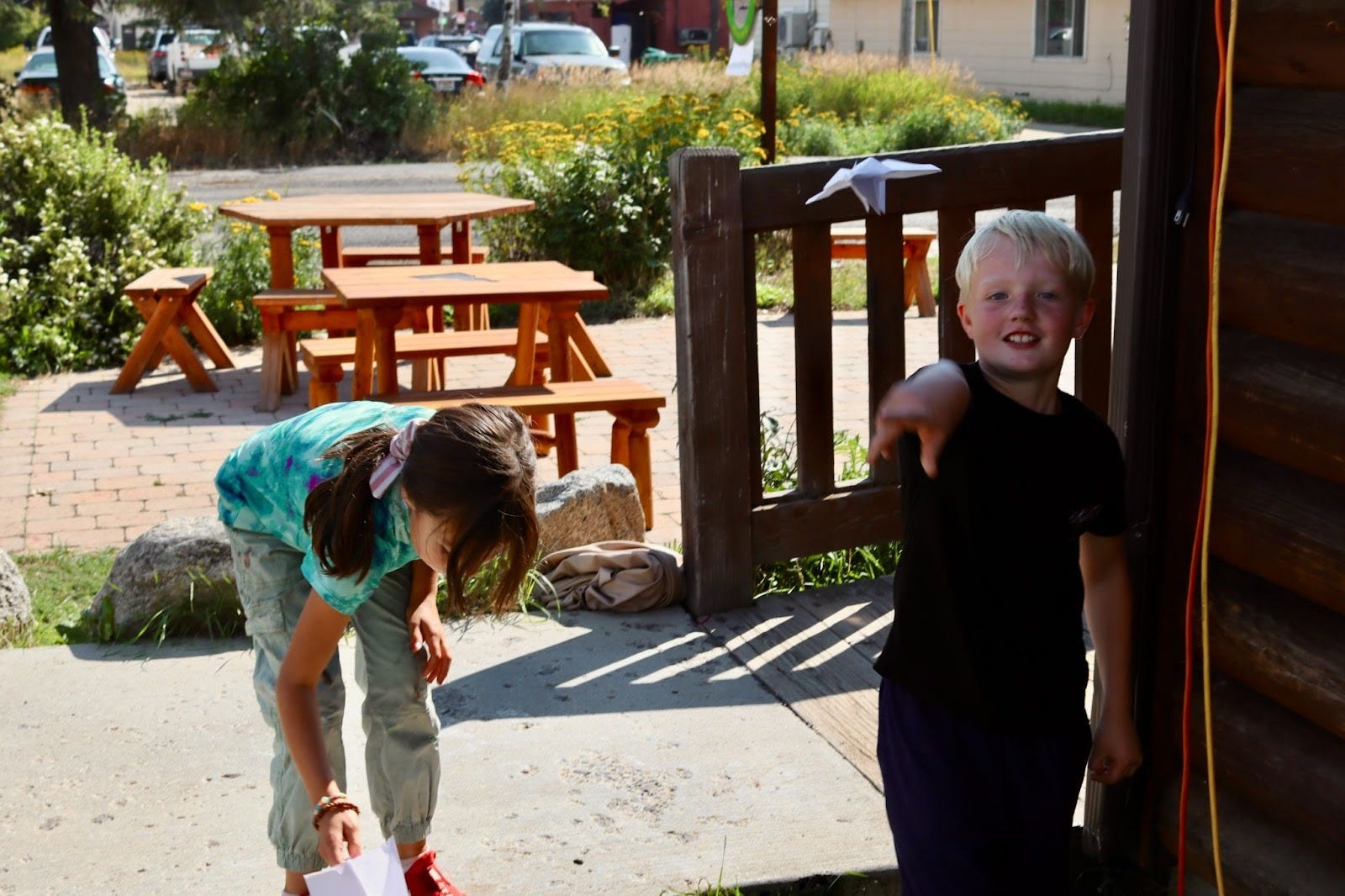
Armed with our fleet of little concordes, we stepped out into the hot sunlight and, one-by-one, released them onto the lawn. Airplanes barrel-rolled, swooped, and plummeted through the air to a chorus of cheers and laughter. We all applauded as Jasmine’s made it out of the library grounds onto the curb.
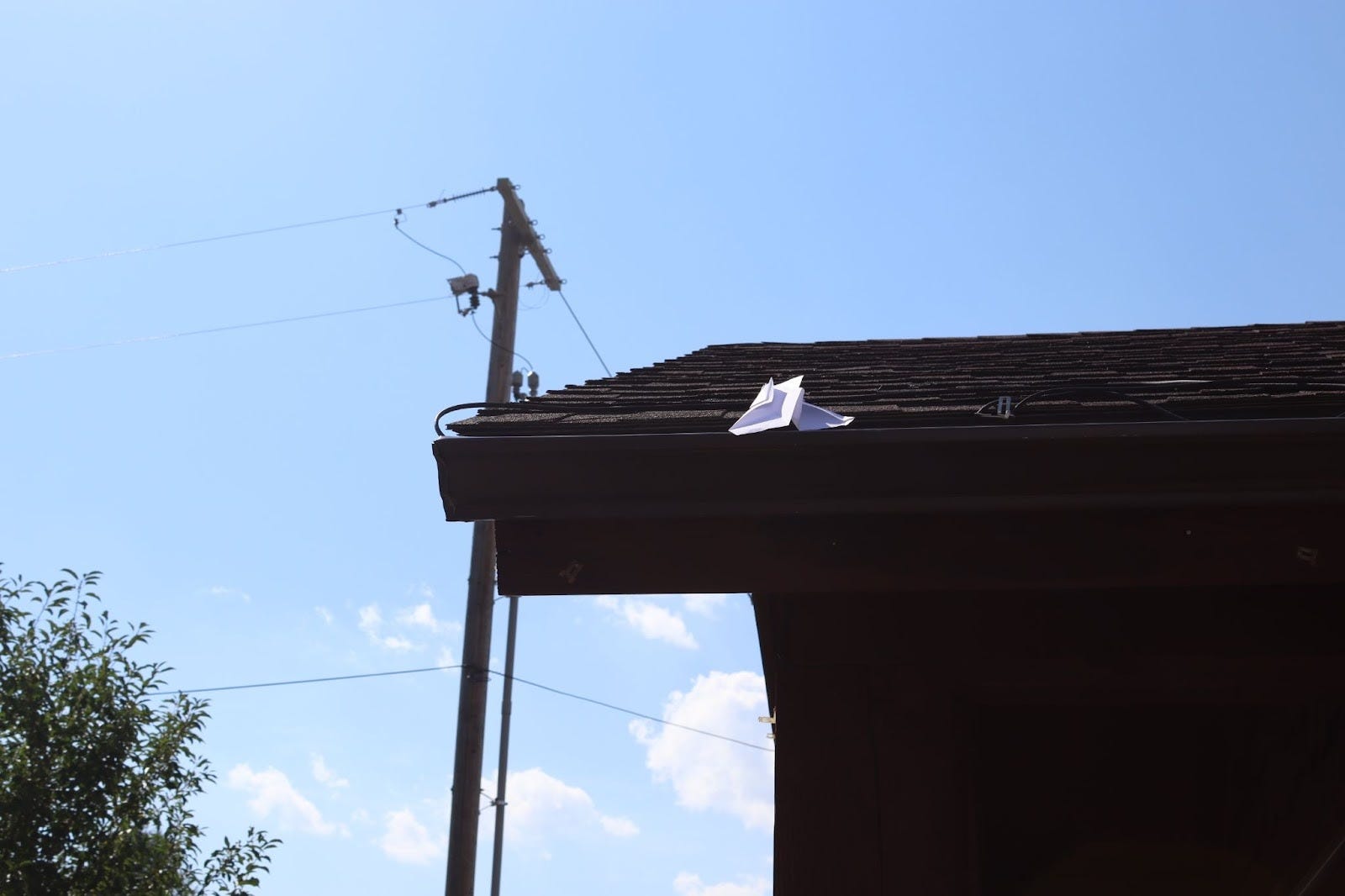
At some point Rylan decided to throw his paper airplane at me. Despite my attempts to dodge, duck, dip, dive, and dodge, he struck my arm on his third attempt. I performed an Oscar-worthy, cinematic death scene that I recall now as a perfect blend of Ian McKellen in Macbeth and Leonardo DiCaprio in Titanic. This, it seemed, was comical enough to prompt an additional five-minute onslaught of paper airplanes from the other children, until Rylan’s airplane, sick of its master’s ill intent, rebelled by climbing into the air and nosediving into the library roof.
Before I had time to gasp, Jasmine darted inside and emerged with her mother behind her carrying a step ladder. “Jasmine,” said Sherry, “what are the rules for using the ladder?”
“Be careful,” she replied instinctively, suggesting the frequency with which she rehearsed these rules. “And wait for somebody to hold the ladder before you go up.”
“That’s right. Go on then.”
Within seconds, the eight-year-old was holding onto the top rung with one hand, reaching out for Rylan’s airplane with the other. And then, just as swiftly, she was back on the ground, returning the contraption to her friend with a grin like it was no effort at all.
We went back inside to finish the lesson with a short quiz. “Can we go to Smiley?” Jasmine asked part way through a question about motion.
“We’ll see if we have time,” replied her mother, adding, “and if Oliver and Carmen want to.” Sherry explained that Smiley was their name for a nearby creek, where the girls sometimes go to swim. Jasmine told me later that it is her favorite place in the world. We said that we would be delighted to join.
But before that, the children were horrified to learn that I had never tried American cotton candy. So after the lesson, we started up the library’s cotton candy machine – one of the unique items in the Donnelly Public Library’s Library of Things, which anyone with a library card can check out. The students quickly became teachers as Jasmine and Rylan gathered swirling wisps of pink and blue into bundles. Then, they taught us the correct etiquette for eating cotton candy: gleeful gobbling, laughing, and jumping up and down.
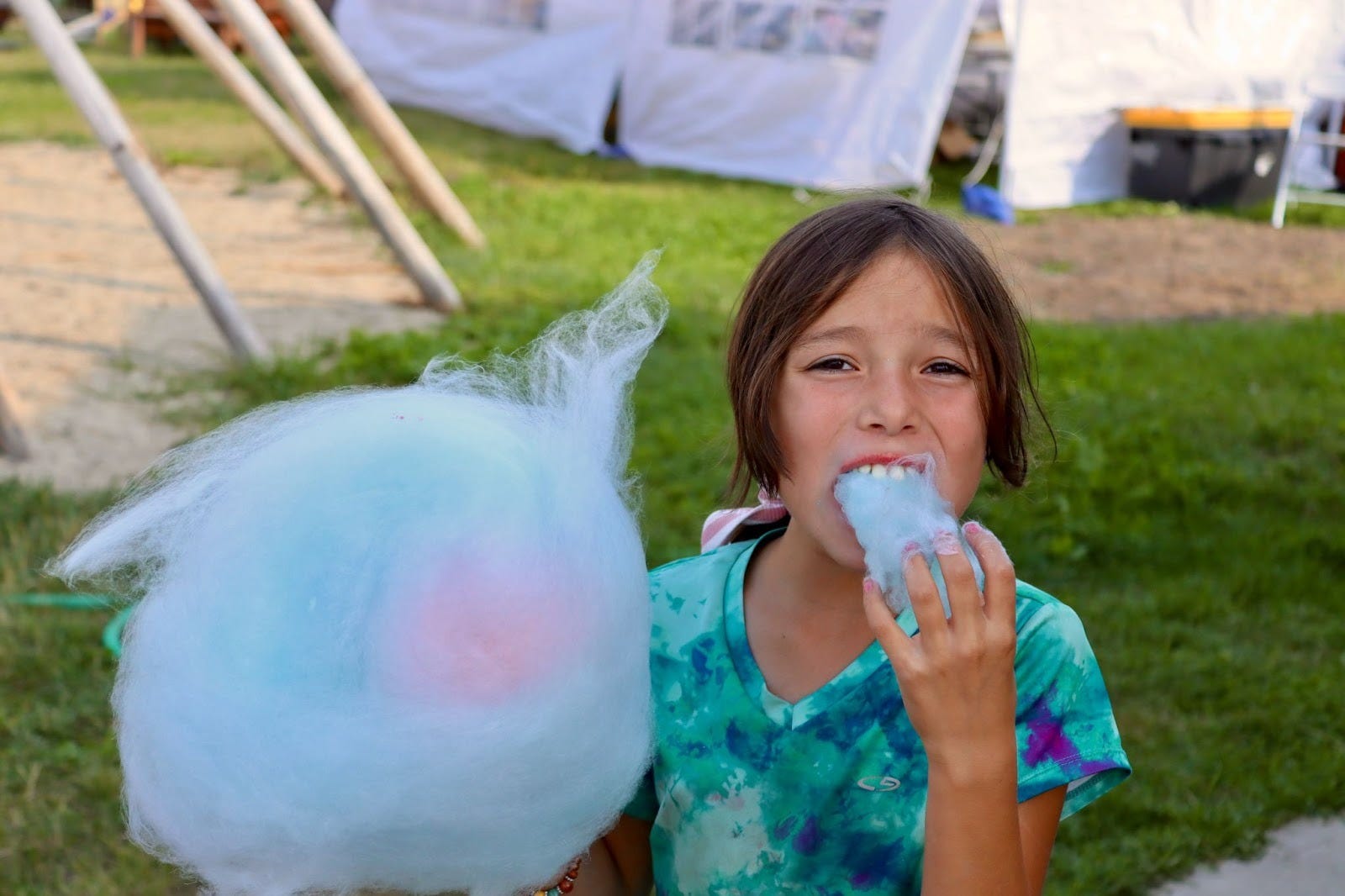
Afterward, Jasmine sat with us in front of the library. Late afternoon sunshine washed us in a soft gold. “Jasmine,” I asked, “what’s your favorite thing about the library?”
“My favorite thing about the library,” Jasmine replied, “is that we get to hear the nature outside. I get to hear birds tweeting, bees buzzing, and the wind.”
An hour later we were back in the car following Sherry to their family ranch, where Jasmine produced the snakes as we pitched the tent. Jasmine and Aiyanna were ecstatic as we swapped our car for a dirt buggy and headed over to Smiley, their secluded ravine.
When we arrived, the girls darted out of the car, sprinting to a spot where they knew they could find clams. Carmen ran after them. Barefoot, I followed cautiously through the prickly grass, taking care to keep to the thin sandy path as I tried to keep up. By the time I had arrived, Carmen was inspecting the fistfuls of clams the “wild girls” were excitedly showing her. I had barely trundled to a stop when the girls returned the clams and started to sprint again, this time in the opposite direction: Jasmine, her sister, then Carmen.
Jasmine was totally unafraid of the cold rushing water; she charged into the stream with a splash as we tiptoed into the shallows, squealing behind our fearless leader. Sherry watched from the bank. “Home time soon, girls!” she called. Her daughters groaned: “Five more minutes!” they protested.
The silhouettes of mountains loomed softly on the horizon as we drove home in silence, sedated by the long day and the splendor of the sunset. When we arrived, we ate dinner family-style, which Kathy had lovingly prepared for us while we were out. We held hands as Clifford said Grace. He thanked God for his incredible family, and prayed for our safety on the long road ahead.
Oliver Jakes
To read more stories from America’s public libraries, subscribe to our Substack below, visit our website and follow us on social media.